
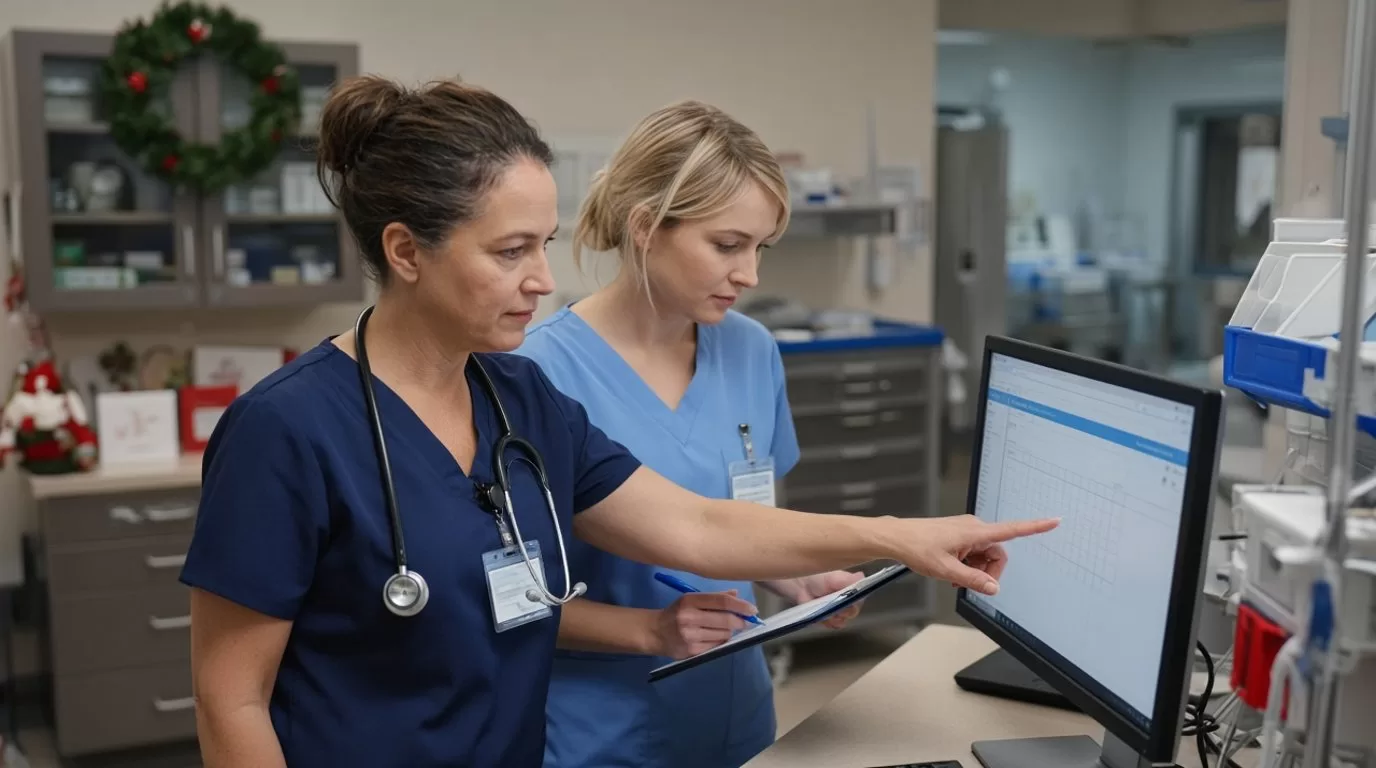
You got the news in October: a bright-eyed new grad starts orientation the week before Thanksgiving. Your unit already runs lean through December, half your team has PTO booked, and patient census never dips during flu season. Now you're tasked with turning a nursing student into a confident bedside nurse while the schedule falls apart around you.
Welcome to holiday precepting — the annual test of every nurse preceptor's ability to teach core skills when normal structure evaporates. The good news? Thousands of preceptors navigate new grad orientation during the busiest weeks of the year and produce excellent nurses. The secret lies in adapting your playbook before chaos peaks, not scrambling when it does.
Here's how experienced preceptors protect new grad development when holiday staffing, patient surges, and compressed schedules collide.
Frontload the Foundation in Week One
Traditional orientation models spread baseline competencies across the first month. That worked when schedules held steady. During holiday months, you can't count on consecutive shifts or consistent unit assignments. The American Nurses Association's 2025 Transition to Practice survey found that new graduates who completed initial skills verification within the first seven days reported 34% higher confidence at the three-month mark compared to those whose assessments stretched beyond two weeks.
Start with the non-negotiables on day one and two:
- Medication administration workflow and double-check protocols
- EHR documentation requirements and where to find critical patient data
- Emergency equipment location and code response procedures
- Unit communication patterns — who to call, when, and through which system
- Handoff structure and what constitutes a complete report
- Isolation precautions and PPE disposal for your specific unit layout
These aren't exciting topics, but they're the scaffolding that lets a new grad function independently during the moments you're pulled away. And you will be pulled away during the holidays — to cover a break, take a rapid response, absorb an extra admission when staffing falls short.
Block the first two shifts for skills demonstration and return demonstration before patient load increases. Resist the urge to “just get through the week” and defer teaching. That debt compounds fast when your next scheduled shift together is nine days away because of holiday coverage gaps.
Build Contingency Scenarios Into Every Shift
Holiday precepting means normal teaching opportunities vanish without warning. You planned to demonstrate central line dressing changes during morning care, but your patient was discharged at 6 a.m. to free the bed. You intended to walk through chest tube management, but the pulmonary patient transferred to ICU overnight. The post-op surgical case you were counting on for wound care teaching? Delayed in pre-op for three hours.
Experienced preceptors keep three contingency clinical scenarios ready every shift — real patient situations you can pivot to when Plan A dissolves. These aren't theoretical case studies. They're actual patients on the unit whose care offers teaching value even if they weren't originally assigned to you.
At the start of each shift, identify backup learning opportunities: a patient with a new insulin regimen two doors down, someone on telemetry with rhythm changes worth reviewing, a confused patient whose fall risk assessment demonstrates safety protocols in action. When your planned teaching moment evaporates, you have a live alternative already scouted.
This approach borrows from the Joint Commission's clinical learning environment standards, which emphasize opportunistic teaching using available resources rather than waiting for perfect scenarios. During the holidays, perfect scenarios don't exist. Good-enough scenarios that happen beat ideal scenarios that don't.
The Fifteen-Minute Window Strategy
December doesn't offer uninterrupted hours for step-by-step skill building. It offers fifteen-minute windows between interruptions. Adapt your teaching to match.
Break complex competencies into small modules that fit available time. Instead of a 90-minute comprehensive wound care session, teach dressing removal in one window, wound bed assessment in another, and documentation requirements in a third. Your new grad absorbs more from three focused 15-minute segments spread across a week than from one rushed lecture delivered while both of you are thinking about the next admission rolling off the elevator.
Use pocket cards or one-page quick-reference sheets for skill steps. When you have eight minutes before the IV pump alarm you're expecting goes off, your orientee can review the saline lock procedure steps while you're both still in the room. Those micro-learning moments add up.
Protect Reflection Time Even When Schedules Compress
The National Council of State Boards of Nursing's 2024 transition to practice model identifies structured reflection as a core element of new grad development. During holiday staffing crunches, reflection time is the first thing that disappears — which is exactly when new graduates need it most.
You can't always protect an hour at shift end for debriefing. You can protect five minutes in the medication room mid-shift. Ask one good question: “What surprised you about that patient interaction?” or “What would you do differently next time?” or “What's one thing you learned this shift that you'll remember?”
Brief, frequent reflection beats long delayed reflection. Your new grad processes the missed IV start better in a three-minute conversation two hours after it happened than in a formal review three days later when the details have blurred.
When your schedules don't align for a week because of holiday coverage, text a reflection prompt: “Thinking about that rapid response on Tuesday — what were the first two signs that patient was decompensating?” You're not looking for a dissertation. You're keeping cognitive processing active between shifts so learning doesn't stall during gaps.
Document Progress Daily, Not Weekly
Standard preceptor practice says complete competency checklists weekly or bi-weekly. Holiday preceptor practice says document every single shift, even if it's three bullet points in your phone notes app that you'll transfer to official paperwork later.
Why? Because when you work Monday, your orientee works Tuesday and Wednesday with a different preceptor, Thursday you're both off, Friday the unit's short and your orientee floats to med-surg, and you finally reconnect the following Monday — you've lost continuity. You can't remember what you covered eleven days ago without notes. Neither can they.
Real-time documentation creates a running record that any preceptor can reference. When you're off and another nurse precepts your orientee for a shift, they can read what's already been covered and what still needs work. This shared knowledge prevents redundant teaching (“someone already showed me that”) and gaps (“nobody taught me that”).
Keep it simple. After each shift:
- Three skills practiced
- Two skills mastered
- One priority for next shift
- Any safety concerns or knowledge gaps that need immediate attention
Four lines of notes, sixty seconds of typing, enormous value when orientation stretches across fractured schedules.
Name the Chaos, Then Normalize It
New graduates arrive with idealized expectations built during structured clinical rotations. Their first exposure to bedside nursing shouldn't feel like a bait-and-switch when reality doesn't match the textbook.
Tell them on day one: “This is holiday staffing. It's messier than February, busier than April, and less predictable than any other time of year. You're going to see nurses juggling higher patient loads, handling admits without full handoffs because the ED is slammed, and making real-time priority decisions that don't appear in any care plan. That's not poor nursing. That's adaptive nursing. And you're learning it now because if you can function during December, you can function any month.”
Naming the chaos removes the hidden curriculum. Your orientee isn't left wondering if normal nursing is always this frantic or if they're in a uniquely dysfunctional environment. They understand context — this is seasonal surge, not permanent state.
Then normalize adapting to it. Point out the expert moves you make: “I just clustered wound care with the bed bath because I know we're getting an admission in twenty minutes.” “I'm calling report to the next shift earlier than usual because two people called out tonight and they'll need extra time to organize.” “I didn't chart that patient education in real time — I'm batching documentation at 1400 when things slow down.”
These aren't corner-cutting. They're professional judgment calls that experienced nurses make constantly during high-volume periods. When you voice your clinical reasoning out loud, your new grad learns the thinking behind the doing.
Coordinate With Other Preceptors Before Schedules Fragment
Your new grad won't work exclusively with you through the holidays. They'll rotate through several preceptors as the schedule accommodates PTO, shift differentials, and coverage needs. Uncoordinated precepting creates duplication and gaps. Three different nurses teach the same IV start technique three different ways. Nobody teaches chest tube stripping because everyone assumes someone else covered it.
The week before Thanksgiving, hold a ten-minute stand-up meeting with everyone who will precept your orientee over the next six weeks. It doesn't need to be formal. It happens in the break room before shift change.
Divide competencies. Preceptor one owns medication administration and IV skills. Preceptor two takes wound care and drains. Preceptor three covers telemetry and cardiac assessment. Preceptor four handles difficult conversations and family communication. Everyone knows their lane, the new grad gets comprehensive coverage without redundancy, and no one assumes someone else will “get to it eventually.”
Share one contact method — a group text, a shared note in the unit communication app, a physical handoff sheet in the preceptor binder. When Preceptor Two finishes wound care teaching on Tuesday, they note it. When Preceptor Three picks up the orientee Friday, they know exactly where to start.
Give Permission to Extend the Timeline
Some new graduates will complete orientation on schedule despite holiday chaos. Others won't, and that's okay. Extending orientation by two weeks because a new grad didn't get adequate exposure to critical skills during a fractured November and December schedule isn't failure. It's quality assurance.
The Bureau of Labor Statistics reports that nursing turnover costs hospitals between $40,000 and $64,000 per nurse when orientation is rushed and new graduates leave within the first year due to inadequacy feelings. Two extra weeks of supported practice costs far less than a failed orientation and a vacant position in March.
Have the conversation early if you see your orientee struggling to gain traction. “You're doing well with the skills you've practiced, but we haven't had enough consistent shifts to cover everything. I'm recommending we extend your orientation three weeks so you get full competency verification without feeling rushed. That's not a reflection on you — that's me protecting your license and your confidence.”
Most new graduates feel relief, not shame, when a preceptor names the gap and offers a solution. What creates anxiety is silent concern followed by abrupt “you're not ready” pronouncements at the end of a fixed timeline.
Close With the Win
Every shift during holiday precepting ends the same way, even the disasters. Especially the disasters.
Before you both leave, name one thing your new grad did well. Not participation-trophy praise (“you showed up”). Real skill acknowledgment. “Your assessment on the post-op patient was thorough — you caught the decreased bowel sounds before they became an issue.” “The way you repositioned that confused patient was gentle and efficient.” “Your IV start in that dehydrated patient on the first stick was solid technique.”
New graduates remember criticism in detail and positive feedback in vague generalities unless you make the positive specific. During chaotic weeks when nothing goes according to plan and they're questioning whether they can actually do this job, concrete evidence of competence matters.
Holiday precepting isn't the ideal time to onboard a new nurse. But it's the time we've got. With frontloaded skills verification, contingency teaching plans, real-time documentation, and a little extra grace for compressed schedules, you'll guide your new grad through the chaos and into confident practice.
Looking for your next preceptor-friendly contract where orientation structure is built into the staffing model — not an afterthought during surge season? Email contact@intuites.healthcare with your specialty and the type of unit culture that lets you teach effectively, even during the busiest weeks of the year.
Sources
Ready for your next nursing assignment?
Browse open nursing jobs across the US — weekly pay, stipends, and a recruiter who reads every application.