
You are scrolling through PT memes at two in the morning after a double because your brain will not shut off. You have seen the jokes about manual therapy being “just expensive touching,’ the TikToks about patients who swear they did their home exercise program, and the endless debates about dry needling scope of practice.
But nobody has tackled the real taxonomy question: if physical therapists were dog breeds, what would each specialty be?
We are going there. This is unserious, unscientific, and uncomfortably accurate. You will recognize yourself, your coworkers, and that one traveler who rotated through your facility last spring.
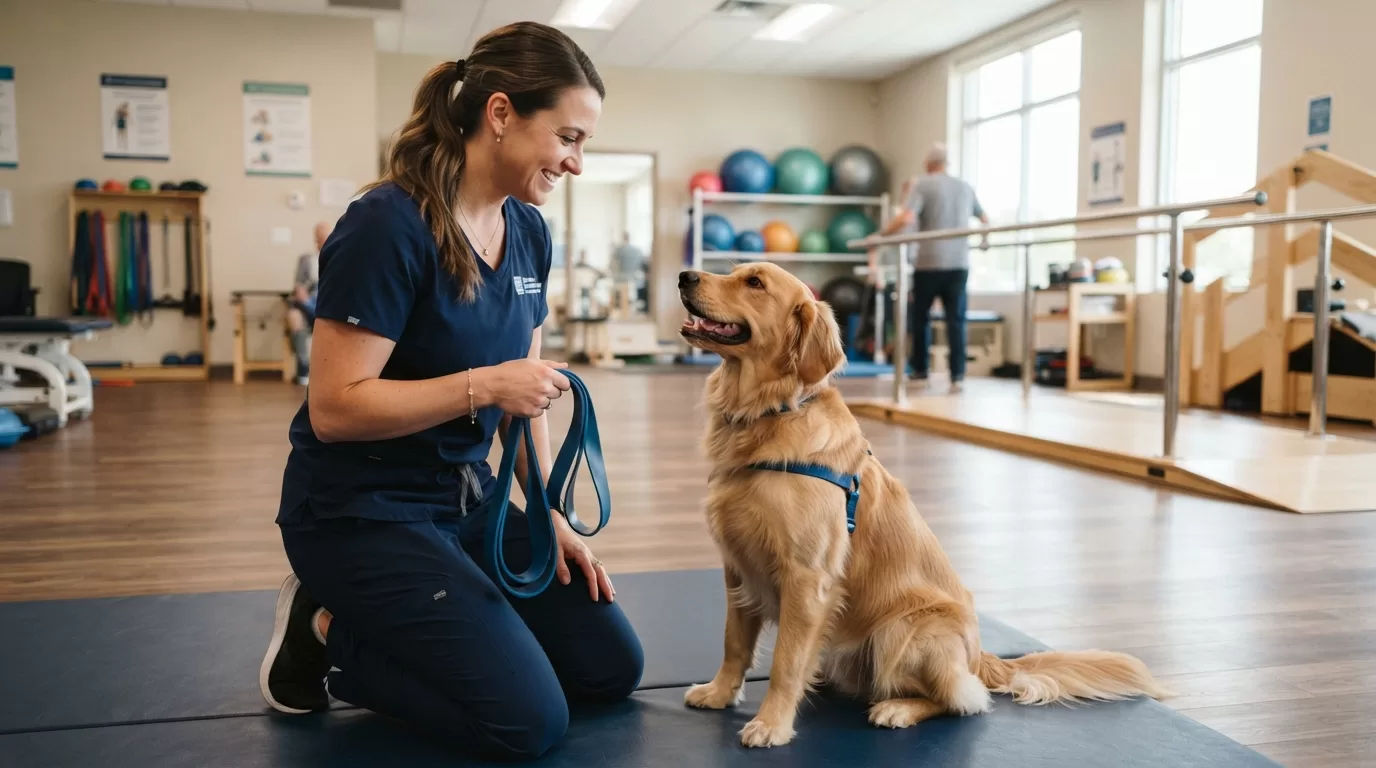
Outpatient Ortho: The Golden Retriever
Outpatient orthopedic PTs are golden retrievers. Enthusiastic, endlessly optimistic, convinced that everyone can get better with the right combination of exercises and encouragement.
You love a good success story. That ACL reconstruction who comes back for a running eval six months post-op? That is your entire reason for existing. You have an actual folder on your phone of before-and-after videos. You have shown them to strangers at parties.
Your treatment plans are ambitious. You believe in functional movement screening, you have opinions about the hip hinge, and you own at least three different foam rollers. You get genuinely excited when someone finally nails a single-leg squat. The American Physical Therapy Association notes that musculoskeletal care remains the largest practice area in the profession, and golden retrievers — sorry, outpatient ortho PTs — are the reason why.
Downside: you are so positive that sometimes you miss the red flags. Not every shoulder pain is rotator cuff tendinopathy. Sometimes it is referred cardiac pain, and your patient needs an ER, not a resistance band.
Acute Care Hospital PT: The German Shepherd
Acute care PTs are German shepherds. Alert, protective, always scanning for danger.
You walk into a room and immediately assess lines, drips, oxygen delivery, and whether the patient is about to pull their own chest tube. You read the chart before you read the consult. You know which nurses will page you for a legitimate fall risk and which ones think PT means ‘person who moves furniture.’
You are the one who catches the occult hip fracture the medical team missed. You are the one who notices the new neuro change during a sit-to-stand transfer and calls a stroke alert. The Bureau of Labor Statistics projects seventeen percent growth for physical therapists through 2031, and acute care roles are driving a significant portion of that demand as hospitals expand early mobilization protocols.
Your documentation is meticulous. You write like you are already being deposed, because one time you were.
Downside: you have seen things. You do not trust anyone. You assume every patient is a fall risk until proven otherwise, and you have trust issues with bed alarms.
Neuro PT: The Border Collie
Neuro PTs — especially the ones who subspecialize in vestibular or stroke rehab — are border collies. Intense, obsessive, and secretly judging everyone else for not caring enough about the vestibulo-ocular reflex.
You live for the complicated cases. Give you a patient with cerebellar ataxia, nystagmus, and a complicated medication list, and you are happy for a week. You attend every continuing education course on neuroplasticity. You have read the entire Bobath concept literature, and you have *opinions* about constraint-induced movement therapy.
You can talk for forty-five minutes about why the Dix-Hallpike maneuver is performed the way it is. Your coworkers have learned not to ask casual questions, because there is no such thing as a casual neuro answer.
Downside: you are exhausting. You need a hobby that is not the nervous system. Your friends are worried about you.
Pelvic Floor PT: Also a Border Collie, But Make It Niche
Pelvic floor PTs are border collies with a subspecialty. You went deep into one very specific area, and now you know more about the pelvic girdle than most OB-GYNs.
You are tired of people making jokes when you tell them what you do. Yes, you work with pelvic pain, incontinence, and postpartum recovery. No, it is not weird. It is evidence-based manual therapy and therapeutic exercise, and you are saving people from years of suffering that they were told was ‘just part of getting older.’
You casually drop terms like ‘levator ani’ and ‘obturator internus’ into conversation and wonder why people look uncomfortable.
Pediatric PT: The Papillon
Pediatric PTs — especially NICU and early intervention specialists — are papillons. Small, delicate, precise, and way tougher than they look.
You work with patients who weigh less than five pounds. You assess primitive reflexes, monitor tone, and position infants for optimal development while they are still on ventilators. You celebrate milestones measured in grams and breaths per minute. You have cried in your car after a shift more times than you can count, and you have also experienced joy that other specialties will never understand.
The National Institutes of Health funds ongoing research into early mobility interventions for preterm infants, and your work is directly contributing to developmental outcomes that last a lifetime.
Your documentation includes phrases like ‘tolerates handling’ and ‘desaturated briefly during intervention.’ You communicate with families in ways that are both hopeful and painfully honest.
Downside: you carry a lot. You have learned to hold space for grief and hope at the same time, and some days the weight of that is heavy.
Home Health PT: The Labrador Retriever
Home health PTs are Labs. Adaptable, resourceful, comfortable in any environment, and totally unfazed by chaos.
You have treated patients in trailers, mansions, hoarder houses, and one memorable apartment that had a live chicken in the kitchen. You have MacGyvered resistance exercises using soup cans, milk jugs, and one time a sack of potatoes. You do not need a gym. You do not even need a level surface. You can run a full eval in a hallway.
You know which neighborhoods have the meanest dogs. You know which patients will actually do their HEP and which ones are just being polite. You have become an expert in Medicare home health documentation because one missed checkbox can tank an entire claim.
- You carry your own hand sanitizer, and you use it constantly.
- You have a mental map of every grocery store, gas station, and coffee shop in your coverage area.
- You can parallel park a Subaru in spaces that should not technically fit a Subaru.
- You have learned to read a situation within thirty seconds of walking in the door.
Downside: you spend more time in your car than in your own home. You have forgotten what it is like to have coworkers you see every day.
Sports PT: The Vizsla
Sports PTs are vizslas. Athletic, high-energy, and probably training for a marathon right now.
You work with athletes who are younger, faster, and more motivated than your average outpatient ortho patient. You live for return-to-sport progressions. You own a stopwatch, a lactate threshold monitor, and at least two different brands of kinesiology tape that you have extremely strong opinions about.
You speak fluent coach. You understand periodization, deload weeks, and why a pitcher's shoulder is biomechanically different from a swimmer's shoulder. You get annoyed when people conflate general strength training with sport-specific conditioning.
Downside: your patients are very aware that their livelihood depends on your rehab plan, and that pressure keeps you awake at night.
Skilled Nursing Facility PT: The Beagle
SNF PTs are beagles. Sturdy, steady, nose to the ground, following the trail no matter how long it takes.
You work with patients who have complex medical histories, multiple comorbidities, and goals that are less about running a 5K and more about being able to transfer to the toilet independently. You celebrate small wins: standing tolerance increased by thirty seconds, ambulation distance up by ten feet, a patient who was bedbound last week now taking steps with a walker.
You are undeterred by slow progress. You understand that rehab for an eighty-seven-year-old post-hip-fracture patient looks different than rehab for a twenty-two-year-old post-ACL repair, and both matter equally.
Medicare Part A therapy caps and documentation requirements mean you spend a lot of time justifying medical necessity, but you have gotten very good at writing goals that are functional, measurable, and realistic.
Downside: nobody warns you in PT school how much of this job is managing family expectations and navigating discharge planning drama.
Travel PT: The Husky
Travel PTs are huskies. Independent, adventurous, and possibly making questionable life choices but having a great time doing it.
You have worked in twelve states in the last three years. You know which agencies actually pay on time and which ones ghost you after the contract ends. You have a mental spreadsheet of tax-home rules, stipend structures, and state licensure requirements.
You thrive in chaos. New EMR system? No problem. Unfamiliar patient population? You will figure it out. No orientation and they need you on the floor in twenty minutes? That is just Tuesday.
Downside: you have no idea where you will be in six months, and sometimes that is liberating and sometimes it is just exhausting. You are not sure where home is anymore.
Which One Are You?
Maybe you are a golden retriever who secretly wishes they were a German shepherd. Maybe you are a border collie trapped in a beagle's job. Maybe you are a Labrador who just wants to go home and not think about gait training for twelve consecutive hours.
The beautiful thing about PT is that every specialty needs a different temperament, and there is room for all of us. The profession is growing, the roles are diversifying, and whether you are drawn to high-acuity hospitals or quiet home visits, there is a place where your particular brand of intensity — or calm, or creativity, or stubborn optimism — is exactly what is needed.
If you are a traveler looking for your next contract or wondering whether a different specialty might be a better fit, email contact@intuites.healthcare with the setting you are curious about — we will walk you through what each role actually looks like day to day.
Sources
Ready for your next allied health assignment?
Browse open allied health jobs across the US — weekly pay, stipends, and a recruiter who reads every application.