Marissa had been working nights in the radiology department for six years when she positioned Mrs. Chen for what seemed like a routine chest X-ray. The order read “pre-op clearance” — standard protocol before a scheduled knee replacement. Mrs. Chen was sixty-two, active, no respiratory complaints. Just another box to check before surgery.
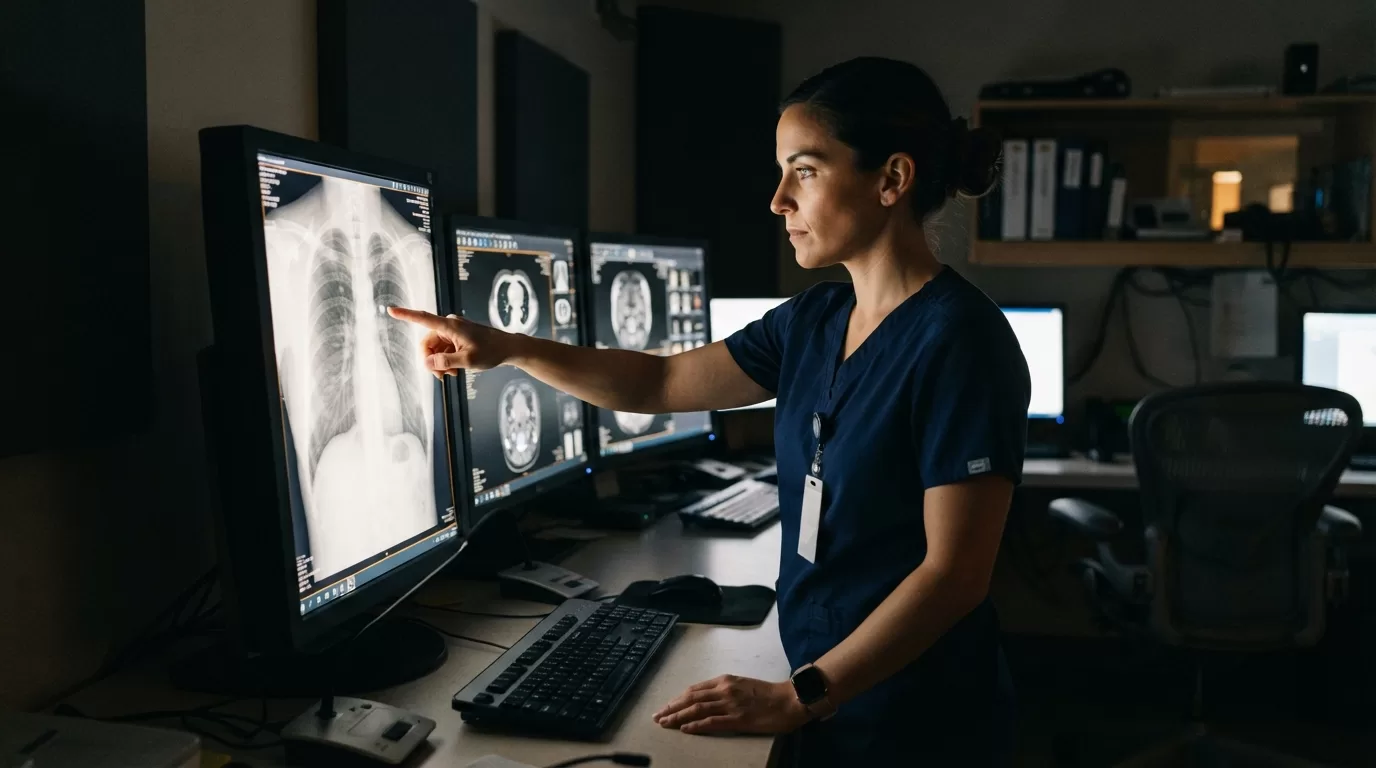
But when Marissa processed the image and pulled it up on her screen, something made her pause. A shadow. Subtle. Right upper lobe, partially obscured by the clavicle. She adjusted the window and level settings, zoomed in, studied it from every angle her workstation allowed.
The preliminary read came back twenty minutes later: “No acute cardiopulmonary process.” Surgery cleared to proceed. Marissa stared at that shadow again. Then she did something that would change a patient’s life — and test every ounce of her professional courage.
The Weight of What You See
According to the American Society of Radiologic Technologists, imaging technologists are often the first healthcare professionals to view diagnostic studies. You position the patient, optimize the technical factors, and quality-check the images before they ever reach a radiologist’s reading list. That puts you in a unique space — you see things first, and sometimes you see things others might miss.
Marissa knew the protocol. Technologists observe and document; radiologists interpret and diagnose. The line is clear, taught in every program, reinforced in every department policy. But she also knew what her eyes were telling her, and six years of night shifts had taught her to trust her pattern recognition.
She pulled up Mrs. Chen’s prior imaging from eighteen months earlier. Clean. No comparable density. This shadow was new.
The question that haunted her through the rest of that shift: What do you do when you see something that matters, but the official read says otherwise?
The Advocacy Path That Actually Works
Marissa did not call the surgeon. She did not approach Mrs. Chen directly. She did not post about it in the department group chat or vent to her coworker at the coffee station. Instead, she followed a path that every imaging tech should know exists:
- She documented her observation in the technologist notes field, describing the location, characteristics, and her recommendation for radiologist review with comparison to priors
- She messaged the on-call radiologist through the secure hospital communication system, using objective language: “Subtle opacity RUL, new compared to 18-month prior, partially obscured by clavicle on frontal view — recommend consideration of additional views or CT correlation”
- She flagged the study as “technologist query” in the PACS workflow, a feature her facility had implemented specifically for this purpose
- She stayed late to ensure the radiologist reviewed her note before signing off
The radiologist — Dr. Patel, someone Marissa had worked with dozens of times — reviewed the images again. He looked at the priors. He adjusted his own window settings. And then he amended his report.
New recommendation: dedicated chest CT within one week. Surgery on hold pending further evaluation.
When Your Gut Knows Something Medicine Can Measure
The CT scan three days later showed a 1.8-centimeter mass in the right upper lobe. Biopsy confirmed early-stage adenocarcinoma. Mrs. Chen’s knee replacement was postponed, but her cancer was caught at Stage 1A — a stage where the five-year survival rate exceeds ninety percent, according to data from the American Cancer Society.
If Marissa had stayed silent, that pre-op X-ray would have been filed as normal. Mrs. Chen would have had her knee surgery. The cancer would have grown silently for months, maybe a year, before symptoms appeared. By then, the prognosis would have been entirely different.
This is not a story about a technologist playing doctor. This is a story about radiology tech advocacy within the scope of professional responsibility. Marissa did not diagnose anything. She observed, documented, and communicated through appropriate channels. She trusted what she saw and knew how to escalate it properly.
The distinction matters. Your value is not in making diagnoses — it is in being excellent observers who know when and how to raise clinical concerns.
The System That Should Exist Everywhere
Marissa’s facility had implemented a formal technologist observation protocol two years before this imaging catch happened. The policy was simple: any tech could flag a study for radiologist re-review if they noted an unexpected finding, and that flag would generate an automatic notification.
Not every hospital has this system. Many still operate on informal relationships — whether a radiologist takes your concern seriously depends on who you are, how long you have worked there, what shift you are on, and whether the radiologist happens to be having a good day.
But the facilities that formalize this process see measurable results. A 2024 study published in the Journal of the American College of Radiology found that structured technologist feedback systems identified clinically significant findings in approximately two percent of cases initially read as normal or nonspecific — findings that included early cancers, fractures, and pulmonary emboli.
Two percent sounds small until you calculate it across the millions of imaging studies performed annually. Two percent represents thousands of patients whose diagnoses were caught earlier because a technologist spoke up and had a system that listened.
What This Means for You on Monday Morning
You might never have a moment as dramatic as Marissa’s. Or you might have one next week. Either way, here is what every diagnostic imaging professional should know about advocating for what you see:
Know your facility’s policy. Does your department have a formal process for technologist observations? If yes, use it every time something does not look right. If no, find out who to contact and how. Document that conversation. If your facility resists creating a formal channel, that is valuable information about whether this is a place that values your clinical input.
Document in real time. Your technologist notes are part of the medical record. Use them. Describe what you see in objective terms: location, size, comparison to priors if available, technical quality of the study. Avoid diagnostic language, but do not soften your observation into invisibility. “Subtle density noted” is useful. “Everything looks fine to me” when you have concerns is not.
Build relationships before you need them. The radiologists who took Marissa seriously knew her work. She had earned credibility through six years of quality imaging, accurate positioning, and thoughtful questions. When she flagged something, they knew it mattered. That trust is built one shift at a time, long before the critical moment arrives.
Understand scope and stay within it. You are not diagnosing. You are observing and communicating. That distinction protects you legally and professionally, and it makes your input more valuable, not less. Radiologists want excellent technologists who see details and speak up appropriately.
Know when to escalate further. If your initial communication is dismissed and you remain concerned, most facilities have a chain of command: lead tech, department manager, radiologist supervisor, patient safety or quality office. Using it is not insubordination. It is professional responsibility.
The Aftermath Nobody Talks About
Three weeks after Mrs. Chen’s diagnosis, she came back to the radiology department for a follow-up scan. She asked to speak with Marissa. The conversation lasted less than five minutes, but Marissa still thinks about it on hard nights.
Mrs. Chen did not say “you saved my life,” though that would have been accurate. She said, “Thank you for paying attention.” And then: “I know you were just doing your job, but I want you to know it mattered.”
Marissa told me later — yes, this story is based on a real conversation with a real tech, details adjusted to protect patient privacy — that what stayed with her was not the gratitude. It was the reminder that paying attention is the job. Trusting what you see is the job. Speaking up through proper channels is the job.
Too many techs carry the weight of things they noticed but did not report, findings they questioned but stayed silent about, moments when they second-guessed their own eyes because someone with more letters after their name had already made the call.
This work asks you to be both humble and confident at the same time — humble about the limits of your scope, confident about the value of your observations. That balance is not easy. But it is exactly what excellent imaging professionals do.
Your Next Step
If you are working in a facility that does not have your back when you advocate appropriately, that does not value your clinical observations, or that makes you feel like raising concerns is risky rather than respected — that tells you something important about where you are. Intuites works with diagnostic imaging departments across the country that are building cultures where tech advocacy is standard protocol, not heroic exception. If you are curious about what those environments look like or ready to explore contracts that put you in facilities doing this work right, reach out to our imaging placement team at contact@intuites.healthcare with “imaging advocacy culture” in the subject line.
Sources
Ready for your next imaging assignment?
Browse open imaging jobs across the US — weekly pay, stipends, and a recruiter who reads every application.