
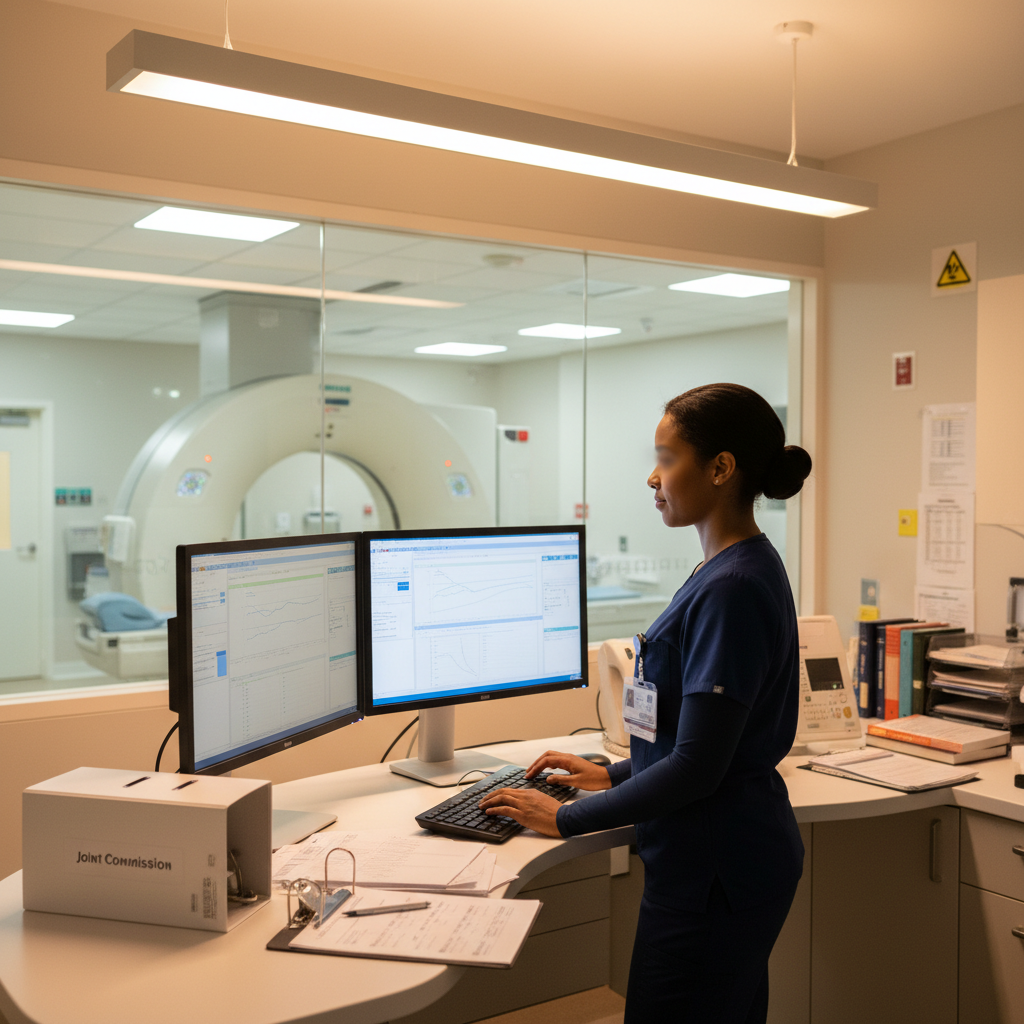
If you are gearing up for your first Joint Commission survey as a radiology or imaging technologist, you are probably feeling a mix of anticipation and nerves. That is completely normal. The Joint Commission visit is one of those milestone moments in a healthcare career — not quite like your first solo shift, but close.
The good news? With the right preparation, you can walk into survey day feeling confident, competent, and ready to demonstrate the excellent work you already do every day. This guide will walk you through exactly what to expect and how to prepare for your first Joint Commission radiology survey.
Understanding What the Joint Commission Actually Looks For
Before we dive into the checklist, let us clarify what surveyors are really evaluating. The Joint Commission is not there to catch you making mistakes or to create gotcha moments. Their mission is to verify that your imaging department consistently follows evidence-based standards that keep patients safe and ensure quality care.
For rad techs specifically, surveyors focus on several core areas:
- Patient identification protocols — How you verify the right patient gets the right exam
- Radiation safety practices — Your use of shielding, dose optimization, and ALARA principles
- Equipment maintenance and quality control — Documentation that machines are calibrated and functioning properly
- Infection prevention — Your cleaning protocols between patients and proper hand hygiene
- Competency documentation — Proof of your credentials, continuing education, and department-specific training
- Medication safety — If you administer contrast, how you verify allergies and follow protocols
Notice a theme? Most of what they are looking for is already part of your daily routine. The survey is about demonstrating that you do these things consistently and can explain why they matter.
Your 30-Day Countdown: Practical Imaging Survey Prep
When you know a survey is coming (or even if you do not — surprise visits happen!), use this timeline to build your confidence and readiness.
Week One: Documentation Review
Start by getting intimately familiar with your department's policies and procedures. You do not need to memorize every word, but you should know where to find key documents and understand the workflows they describe.
Pull out your competency file. Make sure it includes current copies of your ARRT certification, state license (if applicable), BLS card, and any specialized modality credentials. Check expiration dates. If anything is within 60 days of expiring, get your renewal process started now. Surveyors pay close attention to credential currency.
Review your continuing education records. The Joint Commission wants to see that you are maintaining and expanding your skills. If you have completed any manufacturer-specific equipment training, MRI safety updates, or contrast administration courses recently, make sure those certificates are in your file.
Week Two: Protocol Mastery
This is the time to refresh yourself on your facility's specific imaging protocols — not just the technical factors, but the quality and safety measures embedded in each exam type.
For CT and fluoroscopy techs, review your dose reduction strategies. Can you explain how you use automatic exposure control? Do you know your department's diagnostic reference levels? Surveyors often ask rad techs to describe how they balance image quality with radiation safety.
If you work in MRI, make sure you can articulate your screening process for implants and devices. Know where your zone maps are posted and be ready to explain the differences between Zone I, II, III, and IV.
Ultrasound and mammography techs should review their quality control testing schedules and be able to show where results are logged. Surveyors love to see consistent QC documentation.
Week Three: Safety and Environment Walkthroughs
Now look at your department through a surveyor's eyes. Walk through your imaging rooms and work areas with fresh perspective.
Check that all required signage is posted and visible — radiation warning signs, MRI zone markers, hand hygiene reminders, patient rights information. Make sure your emergency equipment (crash cart, fire extinguisher, oxygen) is accessible and current on inspection dates.
Look at your supplies. Are contrast media and medications stored properly with clear labels and expiration dates visible? Are lead aprons hung correctly (never folded) and tested on schedule? Is your PPE stocked and easily accessible?
This is also a good time to verify that your equipment maintenance logs are up to date. If your physicist or biomedical engineer visits are documented in a binder or electronic system, know where to find those records quickly.
Week Four: Practice and Confidence Building
The final week before a survey is about building confidence through practice. Many departments run mock surveys where managers or educators play the role of surveyors and ask questions.
Practice explaining your patient identification process out loud. Walk through how you verify orders, confirm patient identity with two identifiers, and ensure you are doing the correct exam on the correct body part. It might feel silly to rehearse, but being able to articulate your process clearly under pressure is valuable.
If your facility uses the tracer methodology (where surveyors follow a patient's journey through the system), think through how you would explain each step of a typical exam from your perspective — from the moment you greet the patient to the moment you send them on their way.
Survey Day: What to Expect as a Rad Tech
When surveyors arrive in your imaging department, they might observe you during an actual exam, ask you questions about your processes, or request to see specific documentation. Here is how to handle each scenario with professionalism and confidence.
If they observe you during an exam: Just do what you always do. Follow your standard workflow. Use your two-identifier verification process. Explain what you are doing to the patient as you normally would. If you need to check a protocol or look something up, do it — that shows good judgment, not uncertainty.
If they ask you questions: Answer honestly and specifically. If you do not know something, it is perfectly acceptable to say, “I want to give you accurate information, so let me check our policy” or “Let me get my supervisor who can answer that more completely.” Never guess or make up an answer.
If they request documentation: Know where your competency file lives (usually with your manager or in a department binder) and where departmental policies are kept. If records are electronic, know how to access them or who to ask for help.
One important note: Surveyors are specifically trained to put staff at ease. They are not trying to trick you. Most are former healthcare professionals themselves. A calm, honest conversation about your work is exactly what they are looking for.
Common Rad Tech Compliance Questions (and How to Answer Them)
Based on real surveyor interactions, here are questions imaging techs frequently encounter during Joint Commission radiology surveys:
“How do you verify you have the right patient?”
Walk them through your two-identifier process — typically name and date of birth, checked against the order and the patient's wristband. Mention that you ask the patient to state their information rather than asking yes/no questions.
“How do you minimize radiation exposure?”
Talk about ALARA principles, your use of shielding, collimation, appropriate technique factors, and any dose-reduction technology your equipment offers. Mention that you only repeat exams when absolutely necessary for diagnostic quality.
“What would you do if a patient had a reaction to contrast?”
Describe your facility's emergency response protocol — stopping the injection, calling for help, staying with the patient, and following the physician's or rapid response team's directions. Know where your emergency medications are located.
“Show me your most recent continuing education.”
This is why keeping your competency file organized matters. You should be able to produce certificates from the past year or two quickly.
After the Survey: Growth Mindset
Once the surveyors leave and your department receives its report, view any findings as opportunities for improvement rather than criticism. Even the best imaging departments receive recommendations. What matters is how your team responds and implements changes.
Your first Joint Commission survey is a learning experience that will make you a stronger, more confident rad tech. The preparation process itself often reveals gaps in knowledge or documentation that you can address, making your department safer and more efficient.
And here is a secret: after you have been through one survey, the next one feels exponentially easier. You will know what to expect, you will understand the rhythm of the process, and you will have the confidence that comes from experience.
If you are currently preparing for a survey — or if you are considering a new imaging position and want to understand what quality and compliance look like in different facilities — the Intuites Recruiting Team is here to help. We work with rad techs across all modalities to find positions at facilities that value excellence, support professional development, and maintain strong Joint Commission readiness year-round. Reach out anytime at contact@intuites.healthcare or visit intuites.healthcare to explore opportunities. 🤍
Your first survey is a milestone worth celebrating. You have got this.
#JointCommission #RadiologyTech #ImagingSurveyPrep #RadTechCompliance #CTTech #MRITech #XRayTech #UltrasoundTech #MammographyTech #RadiologyAudit #HealthcareCompliance #MedicalImaging #RadTechLife #PatientSafety #QualityImaging
Looking for a healthcare team that truly sees your value?
The Intuites Recruiting Team is here to listen, support your career, and connect you with roles across the USA — when you're ready.