
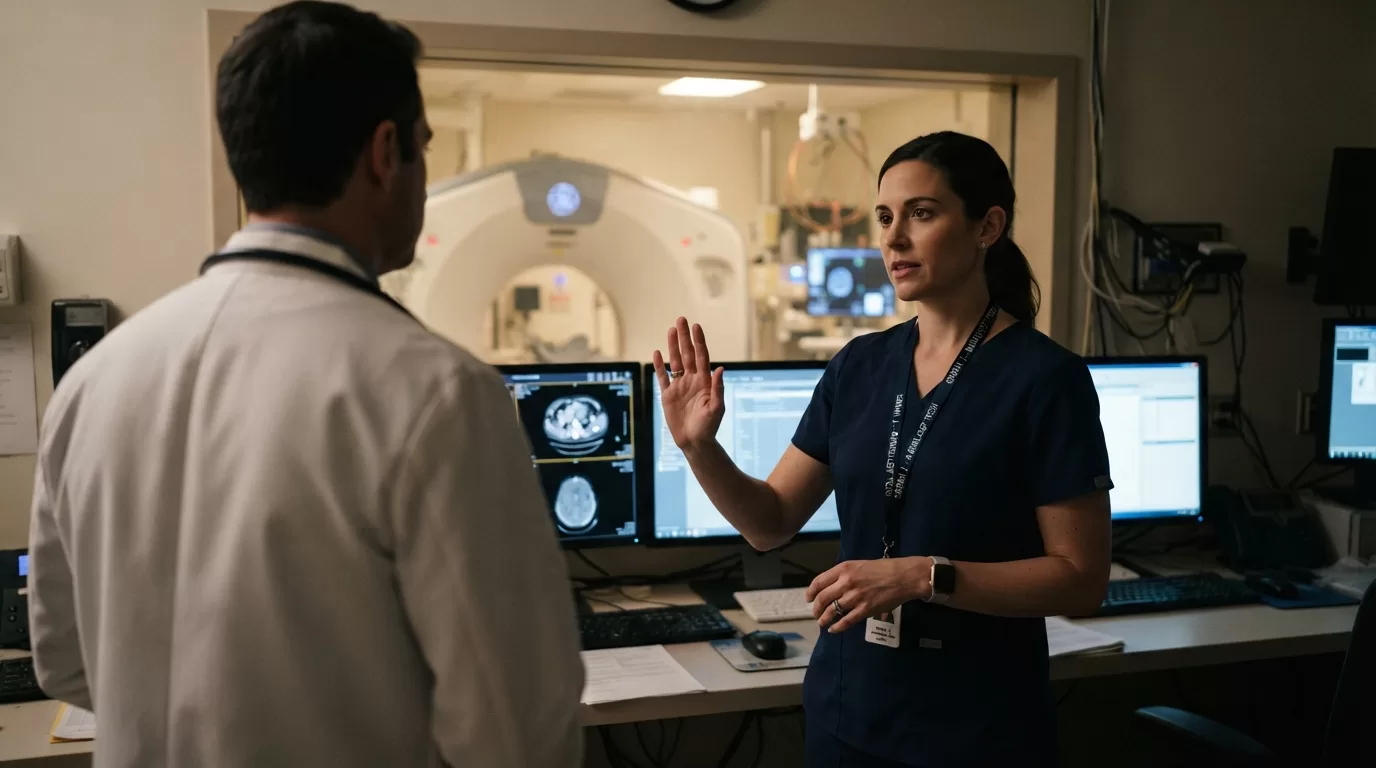
It was a Tuesday morning in the CT suite when Maria finally said the two words she'd been swallowing for three years: ‘That's not my scope.’
The request seemed small. The ER doc needed a central line placed before the contrast study, and the vascular access team was tied up in the ICU. Maria had watched physicians place hundreds of lines. She knew the anatomy cold. Her hands were steady.
But it wasn't her job. And this time, she said so.
The Weight of Small Compromises
Most imaging technologists don't face a single dramatic moment when scope of practice becomes an issue. Instead, it's a slow accumulation of small asks that drift further and further from what your state practice act actually permits.
You adjust the IV rate because the nurse is busy. You remove a Foley catheter after the cystogram because ‘you're right there.’ You interpret preliminary findings over the phone to an anxious family member because the radiologist is reading at another facility. Each request comes with reasonable-sounding justification. Each one chips away at the boundaries that protect both you and your patients.
According to the American Society of Radiologic Technologists, scope of practice violations are among the top three reasons imaging professionals face state board investigations. The ASRT's practice standards emphasize that technologists must practice within the legal scope defined by state law and accreditation requirements — not what a physician requests or what seems efficient in the moment.
Maria had crossed those small lines dozens of times. The day she didn't, everything changed.
What Rad Tech Scope Actually Covers
State practice acts for radiologic technologists vary, but most share common boundaries. Understanding these imaging boundaries isn't about being difficult — it's about protecting your license and ensuring patient safety.
Your scope typically includes:
- Positioning patients and operating imaging equipment according to physician orders
- Following standardized imaging protocols approved by the radiologist
- Administering contrast media when properly trained and credentialed (requirements vary by state)
- Providing basic patient education about the procedure itself
- Recognizing and responding to medical emergencies within your training level
What usually falls outside rad tech scope:
- Placing or removing IV lines, central lines, or urinary catheters (unless you hold additional nursing credentials)
- Adjusting medication dosages or IV drip rates
- Providing diagnostic interpretations or preliminary reads to patients or families
- Modifying physician orders without radiologist approval
- Performing procedures you haven't been trained and credentialed for, even under physician supervision
The gray areas cause the most trouble. Can you adjust the table height for a patient in traction? Can you help transfer a confused patient without a nurse present? Can you scan an area not specified in the order if the physician verbally requests it?
The answer almost always depends on your facility's specific policies, your state's practice act, and whether you've received documented training for that task. ‘The doctor told me to’ is not a legal defense if something goes wrong.
The Moment She Drew the Line
Maria's ‘no’ didn't come from anger or defiance. It came from fear — the healthy kind that keeps professionals safe.
The week before, she'd attended a mandatory training on scope of practice after another tech at a sister facility faced board discipline. The incident involved a contrast reaction that escalated while the tech was attempting a procedure she wasn't trained for. The patient survived, but the technologist's license didn't.
When the ER physician asked Maria to place that central line, she felt the familiar tug to just handle it. She was capable. The patient needed it. The team was stretched thin.
But she also saw the absence of a clear protocol, the lack of documentation that she'd been trained and credentialed for vascular access, and the reality that if anything went wrong, ‘trying to help’ wouldn't matter to the state board.
‘I can't place that line,’ she said. ‘It's outside my scope of practice as a rad tech. I'll call the charge nurse to get vascular access down here, and we can start the scan as soon as the line is in.’
The physician was frustrated. The wait added twenty minutes. But the line was placed by someone credentialed to do it, the scan happened safely, and Maria went home that night with her license intact.
What Happened Next
The aftermath wasn't dramatic. No one applauded Maria for following the law. But three things shifted.
First, she documented the request in an incident report — not to blame the physician, but to create a paper trail showing that scope-of-practice confusion existed in that department. When patterns emerge in incident reports, hospitals are required to address them.
Second, she asked her manager for a meeting to review which tasks were within scope for rad techs at their facility. The conversation revealed that several technologists had different understandings of what they could legally do. Within a month, the department held a refresher training and posted clear guidelines in each imaging suite.
Third, Maria noticed other techs speaking up. The normalized behavior had been to stretch beyond your role when asked. Her refusal — calm, professional, and grounded in actual regulations — gave others permission to do the same.
Saying ‘no’ isn't about being unhelpful. It's about being honest that healthcare roles exist for a reason, and that reason is patient safety.
How to Navigate Imaging Boundaries in Real Time
If you're facing similar requests, here's how to handle them without damaging relationships or your career:
Know your state's practice act. Every state that licenses or certifies radiologic technologists publishes scope-of-practice guidelines. Read yours. If your state doesn't require licensure, your facility's policies and your ARRT certification standards define your scope. Ignorance is not a defense.
Clarify your facility's protocols. Some hospitals credential rad techs for tasks that might surprise you — IV placement, Foley insertion, even certain injections — if you've completed specific training. Other facilities draw much tighter lines. Ask your manager for written documentation of what you're authorized to do.
Use clear, non-confrontational language. ‘I'm not trained and credentialed for that procedure’ is factual and professional. ‘I'm not comfortable with that’ invites debate about your feelings rather than the law. ‘I can't legally do that under my state practice act’ ends the conversation.
Offer an alternative. ‘I'll call the nurse to place that IV while I prep the patient for positioning’ shows you're solution-focused, not obstructive. You're redirecting the task to the right professional, not refusing to help the patient.
Document every boundary conversation. If a physician or supervisor asks you to perform a task outside your scope, document it. Note the date, time, who made the request, what you said, and what happened next. If the request is repeated or pressured, file an incident report. This protects you if the pattern escalates.
Don't practice beyond your competence even if it's within your scope. Just because your state allows contrast administration doesn't mean you should do it without proper training. Just because you're credentialed for portable X-rays doesn't mean you should take one in an isolation room if you haven't been fit-tested for the required respirator. Scope of practice is the ceiling, not the floor.
The Bigger Picture
Maria's story isn't unique. It plays out in imaging departments across the country every week. A tech is asked to do something that feels like a gray area. Pressure mounts. The patient is waiting. The team is short-staffed.
But here's what Maria learned: short-staffing is a system problem, not a reason to practice outside your legal authority. Efficiency is valuable, but not at the cost of patient safety or your license. And the most helpful thing you can do for your team is to practice competently within your defined role, not stretch yourself into areas where you're untrained and unprotected.
The American Registry of Radiologic Technologists maintains a detailed ethics and scope-of-practice resource that every certified tech can access. It includes case studies, decision trees, and state-by-state variations in what rad techs are authorized to do. If you haven't reviewed it since your boards, it's worth an hour of your time.
Eighteen months after Maria said ‘no,’ her department created a formal scope-of-practice committee. Techs, radiologists, nurses, and administrators meet quarterly to clarify boundaries, update protocols, and ensure everyone understands who does what. Requests that fall outside someone's scope are redirected without guilt or drama, because the system finally supports doing the right thing.
Maria still works in that CT suite. She still gets tough requests. But now when she says ‘that's not my scope,’ it's not a career risk — it's just Tuesday.
If you're navigating scope-of-practice questions in your current imaging role or considering a travel contract where expectations might differ from your home facility, reach out to us at contact@intuites.healthcare with your specific concerns — we'll help you understand what's standard, what's negotiable, and what's a red flag before you sign.
Sources
Ready for your next imaging assignment?
Browse open imaging jobs across the US — weekly pay, stipends, and a recruiter who reads every application.