
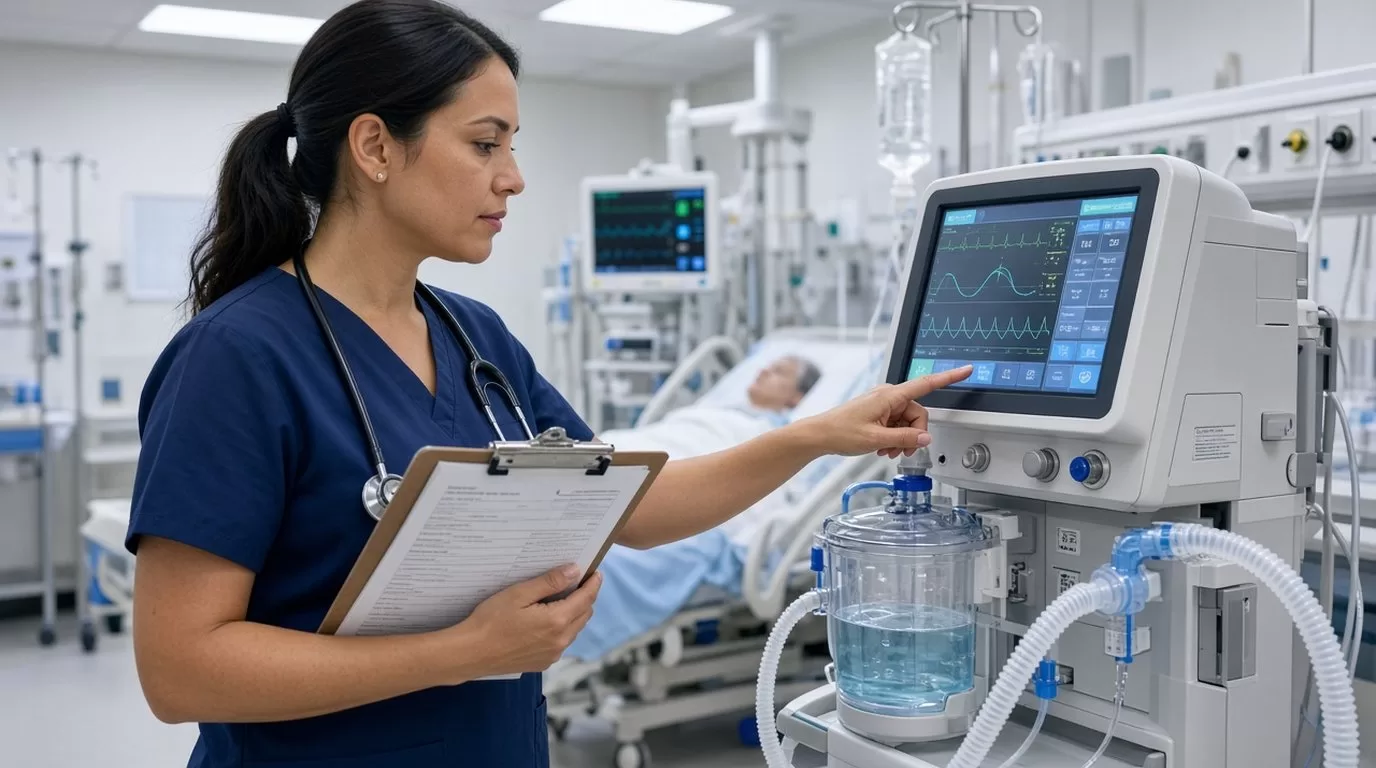
You have cleared the phone screen. Your resume listed every cert and clinical rotation. Now the panel interview is two days away, and you know what is coming: vent scenarios.
Hiring managers for respiratory therapist positions almost always ask situational questions about ventilator management. They want to hear how you think under pressure, troubleshoot alarms, and communicate with the care team. The good news? The same five clinical situations show up again and again.
This quick guide walks you through those five RT vent scenarios, shows you how to structure answers that highlight your clinical judgment, and gives you the framework to finish your morning coffee feeling interview-ready.
Why Hiring Managers Love Vent Scenarios
Panel interviews test more than your ability to recite normal tidal volumes. Respiratory care directors want to see how you prioritize, troubleshoot, and collaborate when a patient desaturates or fights the vent at two in the morning.
According to the Bureau of Labor Statistics, employment of respiratory therapists is projected to grow 13 percent from 2022 to 2032, much faster than the average for all occupations. That growth means more openings — and more competition. Facilities are looking for RTs who can walk onto the floor and handle complex ventilator management without needing a preceptor at their elbow for weeks.
Vent scenarios let interviewers watch your clinical reasoning in real time. They are not looking for a textbook recitation. They want to hear your thought process: what you assess first, when you call the physician, how you document, and how you explain changes to the nurse or family.
How to Structure Every Answer: The STAR Method
Before we dive into the five scenarios, learn the framework that makes any clinical answer clear and memorable. STAR stands for Situation, Task, Action, Result.
- Situation: Set the scene in one or two sentences. What was the patient diagnosis, vent mode, and presenting problem?
- Task: State your responsibility. Were you the primary RT? Did you respond to a code? Were you rounding?
- Action: Walk through what you did, step by step. This is where you show clinical judgment. Mention specific parameters you checked, assessments you performed, and who you collaborated with.
- Result: Quantify the outcome. Did SpO2 improve? Did the patient wean successfully? Did you prevent reintubation?
Interviewers love numbers. Instead of saying “the patient got better,” say “SpO2 increased from 88 to 94 percent within 20 minutes, and we were able to reduce FiO2 from 80 to 60 percent by the end of my shift.”
Scenario One: High-Pressure Alarm and Patient-Ventilator Asynchrony
This is the most common RT vent scenario in panel interviews. The setup: you walk into a room and the high-pressure alarm is sounding. The patient appears to be fighting the ventilator.
What they are testing: Do you know the difference between obstruction, bronchospasm, and dyssynchrony? Can you troubleshoot systematically?
How to answer: Start with your immediate assessment. Say you would check the patient first — look at their work of breathing, listen for breath sounds, check SpO2 and EtCO2. Then move to the circuit: is there a kink in the tubing, water in the line, or a clogged filter?
Walk through your next steps. If breath sounds are diminished on one side, you suspect a mucus plug or pneumothorax and you call the physician. If the patient is biting the tube, you check sedation and request an oral airway or bite block. If the ventilator graphics show dyssynchrony, you discuss adjusting the sensitivity or considering a different mode with the intensivist.
Close with a result. For example: “After suctioning and repositioning the ET tube, peak pressures dropped from 38 to 28 centimeters of water, the alarm stopped, and the patient’s respiratory rate decreased from 32 to 22.”
Scenario Two: Acute Desaturation in a Patient with ARDS
ARDS management is a core competency for ICU respiratory therapists, and interviewers know it. The scenario: a patient with moderate ARDS on lung-protective ventilation suddenly desaturates from 92 to 84 percent.
What they are testing: Do you understand low tidal volume strategies, PEEP titration, and prone positioning? Do you know when to escalate?
How to answer: Begin with your assessment. You would check the ventilator settings — confirm tidal volume is six milliliters per kilogram of ideal body weight, review PEEP and FiO2, and verify the patient is not auto-PEEPing. You would auscultate and suction if needed.
Next, describe your interventions. You might increase FiO2 temporarily while troubleshooting. You would review the most recent chest X-ray and ABG. If the desaturation persists, you would collaborate with the physician about increasing PEEP in increments of two to three centimeters of water, recruiting maneuvers, or proning.
Mention The Joint Commission’s emphasis on evidence-based ARDS protocols. Many hospitals follow ARDSNet guidelines, and saying “I followed our facility’s ARDS protocol, which is based on the ARDSNet low tidal volume strategy” shows you understand standardized care.
Finish with measurable improvement: “After increasing PEEP from 10 to 14 and optimizing the patient’s position, SpO2 improved to 91 percent and we were able to wean FiO2 from 100 to 70 percent over the next two hours.”
Scenario Three: Weaning Readiness and Spontaneous Breathing Trial
Weaning questions test whether you understand liberation protocols and can advocate for patients. The setup: a patient has been intubated for five days post-op. The physician asks if the patient is ready for a spontaneous breathing trial.
What they are testing: Do you know weaning criteria? Can you assess readiness and conduct an SBT safely?
How to answer: List the criteria you would assess. A strong answer includes hemodynamic stability (no pressors or low-dose only), adequate oxygenation (PaO2/FiO2 ratio above 150 to 200, PEEP of five or less), resolution of the underlying cause of respiratory failure, and appropriate mental status (follows commands, GCS above eight).
Describe how you would perform the trial. You would explain the process to the patient and nurse, switch to pressure support of five to seven with PEEP of five (or T-piece, depending on facility protocol), and monitor for 30 minutes. You are watching for respiratory rate above 35, SpO2 drop below 90 percent, heart rate increase of more than 20 percent, new arrhythmias, or diaphoresis and agitation.
Give a specific outcome. “The patient tolerated the 30-minute SBT with a respiratory rate of 18, no accessory muscle use, and SpO2 of 96 percent. I documented a successful trial and the physician extubated two hours later. The patient remained stable on two liters nasal cannula.”
Scenario Four: Troubleshooting Low Tidal Volume Delivery
This scenario tests your circuit and leak troubleshooting skills. The setup: the ventilator is set to deliver 450 milliliters tidal volume in volume control, but the exhaled volume is consistently 200 milliliters lower.
What they are testing: Can you identify circuit leaks, cuff issues, and disconnections? Do you escalate appropriately?
How to answer: Start by checking the patient. Is their chest rising symmetrically? Are breath sounds equal bilaterally? Then move to the circuit systematically. You would inspect all connections, check the humidifier chamber, and verify the exhalation valve is functioning.
Next, assess the ET tube. You would check cuff pressure with a manometer — normal is 20 to 30 centimeters of water. If pressure is low, you inflate the cuff and recheck delivered volume. If the leak persists despite adequate cuff pressure, you suspect a cuff rupture and notify the physician for possible reintubation.
Close with resolution: “After inflating the cuff to 25 centimeters of water, exhaled tidal volume matched the set volume at 450 milliliters. I documented the intervention and educated the nurse to monitor cuff pressure every shift.”
Scenario Five: Managing a Combative Patient Pulling at the ET Tube
This scenario blends clinical and behavioral skills. The setup: you respond to a room where a newly extubated patient was reintubated overnight. The patient is now awake, combative, and reaching for the tube.
What they are testing: Do you prioritize patient safety? Can you work with nursing and pharmacy? Do you understand sedation protocols?
How to answer: Say your first priority is preventing self-extubation. You would ask the nurse to stay at the bedside, apply soft restraints per physician order if the patient is an immediate danger to themselves, and quickly assess why the patient is agitated. Are they in pain? Hypoxic? Delirious?
Describe your collaborative approach. You would check the ventilator settings to ensure the patient is not air-hungry — verify the mode allows for patient-triggered breaths, increase the flow rate if they are tachypneic, and adjust sensitivity. You would review sedation orders with the nurse and request a pharmacist consult or physician reassessment if current sedation is inadequate.
You might also mention reorienting the patient, explaining the tube and ventilator, and asking family to stay if that calms the patient. Finish with an outcome: “After adjusting the vent to pressure support with a higher flow rate and administering additional sedation per protocol, the patient’s respiratory rate decreased and agitation resolved. They remained intubated safely overnight and extubated successfully the next morning.”
Bonus Tips for RT Vent Scenario Answers
Beyond the five scenarios, a few strategies will make every answer stronger. First, always mention ABG interpretation. If you are discussing oxygenation or ventilation changes, reference checking a blood gas. Say something like, “I would review the most recent ABG to confirm PaO2 and PaCO2 trends before making further adjustments.”
Second, emphasize teamwork. Respiratory therapy does not happen in a silo. Mention collaborating with the nurse, calling the physician, or consulting pharmacy. Interviewers want to know you communicate well under pressure.
Third, quantify everything. Instead of “the patient improved,” say “SpO2 increased from 86 to 93 percent” or “peak pressure decreased by 10 centimeters of water.” Numbers prove you pay attention to details and outcomes.
Finally, if you have not encountered one of these exact scenarios in clinicals or previous work, it is okay to say, “I have not managed that specific situation yet, but here is how I would approach it based on my training.” Then walk through your thought process using the STAR method. Honesty and strong clinical reasoning beat a fabricated story every time.
Practice Before the Interview
Reading these scenarios is a good start. Practicing them out loud is better. Grab a classmate, a mentor RT, or even a family member and rehearse your answers. Time yourself — aim for 90 seconds to two minutes per scenario. If you ramble past three minutes, you will lose the panel’s attention.
Write down your STAR framework for each of the five scenarios. Keep it on your phone. Review it the morning of the interview while you are sitting in your car in the parking lot. The structure will keep you calm when the panel says, “Tell us about a time you managed a high-pressure alarm.”
Confidence in allied health interview prep comes from preparation. You already have the clinical skills. Now you have the framework to show them off in a way that hiring managers remember.
If you are ready to put these answers to work and want to explore travel or per diem RT contracts that value strong ventilator skills, email us at contact@intuites.healthcare with “RT Interview Prep” in the subject line and we will connect you with opportunities that match your experience.
Sources
Ready for your next allied health assignment?
Browse open allied health jobs across the US — weekly pay, stipends, and a recruiter who reads every application.