
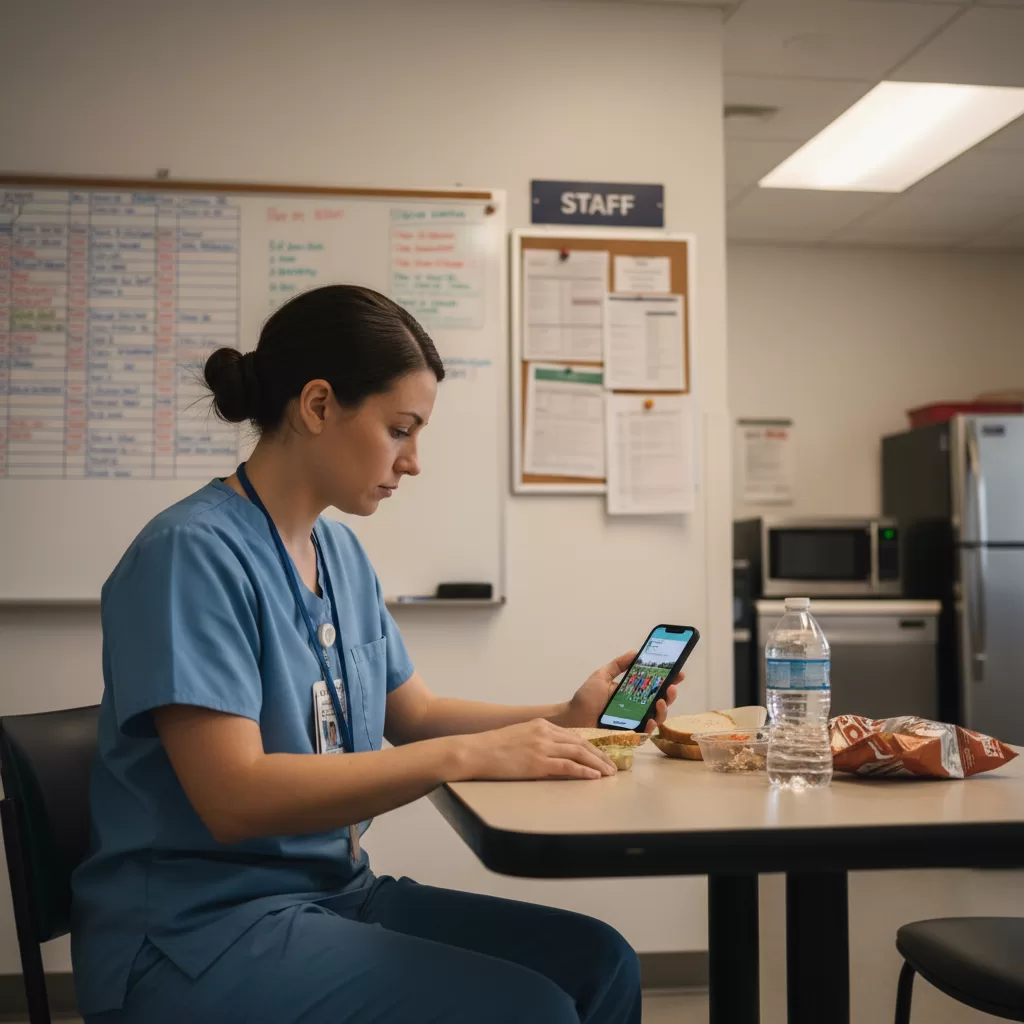
You are pulling into the parking garage at 6:45 a.m. on a Saturday. Your daughter's soccer game starts at nine. You will not be there. Again.
The guilt sits in your chest like something physical. You have already sent the good-luck text. Your partner will record video. Your mother-in-law is bringing the halftime snacks you prepped last night. Everyone says they understand. But you are the one who will miss the goal she scores, or the moment she gets benched and needs your face in the bleachers.
This is the nurse parent guilt no one puts in the job description. It is not about being a bad parent. It is about working weekends when the rest of the world does not, and carrying the weight of that choice every single Saturday you badge in.
The Weekend Shift Reality for Nursing Parents
Healthcare does not stop for soccer season. Someone has to staff the floor on Saturday morning, and if you are a nurse, that someone is often you. The shift work parenting math is brutal: twelve-hour blocks that swallow entire weekend days, schedules posted two weeks out that conflict with game calendars published in August, and the knowledge that your coworkers with older kids or no kids are watching you navigate this in real time.
You are not imagining the cost. Studies on shift work parenting consistently show that non-traditional hours create genuine strain on family connection. But what the research does not always capture is the small, specific heartbreak of missing the unrepeatable moments. The first goal. The championship game. The carpools where your kid talks about things they will not say at dinner.
And here is the other half: you need this job. You are good at this job. Your patients need you, and your family needs your income and your benefits. The guilt is not a sign you are doing something wrong. It is a sign you care deeply about two things that sometimes cannot occupy the same Saturday morning.
What the Guilt Actually Sounds Like
It is not always loud. Sometimes it is the quiet compare-and-despair when you see another parent's photo from the game in the group chat. Sometimes it is your kid saying “it's okay, Mom” in a voice that tries too hard to mean it. Sometimes it is your own voice in your head, listing all the moments you have missed this season, and wondering if they are adding up to something you cannot get back.
The working parent nurse guilt has specific triggers:
- The schedule conflict you see coming but cannot fix because you already swapped shifts last month
- Arriving late to the post-game team dinner, still in scrubs, while other parents have been there since the first whistle
- Your kid's face when you explain, again, that you have to work this weekend
- The group text lighting up during your shift with play-by-play you are reading four hours later
- Knowing your partner or your mom is doing the heavy lifting, and feeling both grateful and inadequate
You do not talk about this in the break room, because everyone is managing their own version of it. You do not post about it, because someone will say you chose this job or you should find a weekday role or just be grateful you are employed. But the guilt is real, and it lives in your body right next to your stethoscope.
The Tiny Rituals That Actually Help
You cannot fix the schedule. You cannot clone yourself. But you can build small, specific practices that create connection even when you are not physically there. These are not Instagram-worthy solutions. They are the things working nurses actually do to stay tethered to their kids when the shift falls on game day.
The pre-shift voice note. Before you leave for your Saturday shift, record a thirty-second message on your kid's phone or your partner's. Say what you would say if you were in the car on the way to the game. “I am thinking about you. I hope you remember to follow through on your kick. I love watching you play.” They can listen to it in the parking lot. It is not the same as being there, but it is not nothing.
The post-shift recap ritual. Do not try to watch the game video during your shift. You will miss things, you will get interrupted, and you will feel worse. Instead, create a specific time after you get home — even if it is late — when your kid walks you through the highlights. Let them narrate. Ask questions. This becomes the thing they can count on: Mom always wants the full story when she gets home.
The one unmissable event per season. If your facility allows any schedule flexibility, protect one game or recital or tournament per season as non-negotiable. Trade for it early. Use a PTO day if you have to. Your kid will remember that you moved heaven and earth to be at the championship, even if you missed five regular-season games.
The makeup time within forty-eight hours. This is not about grand gestures. If you miss Saturday's game, plan something small and specific for Sunday or Monday. Breakfast before school. A walk after dinner. Shooting goals in the backyard for twenty minutes. The message is: I missed the game, but I do not miss you.
What Your Kids Actually Need to Hear
They need to know you are sad about missing it. Not in a way that makes them feel responsible for your feelings, but in a way that shows the game mattered to you. “I really wish I could have been there today” is a sentence that does more than “it is what it is.”
They also need to know that your work matters. Not in a defensive way, but in a way that connects your shift to something real. “I took care of someone's grandma today, and she needed me” gives your absence a shape they can understand. You are not choosing work over them. You are doing work that matters, and also loving them fiercely, and sometimes those two things happen in different places on the same Saturday.
And they need to hear that you see them trying to make it easier on you. When your kid says “it's fine, Mom,” they are trying to take care of you. Acknowledge that. “I know you are being really understanding, and I appreciate that. It is still okay to wish I was there.”
The Long View on Nurse Work-Life Balance
This season of parenting and shift work will not last forever. Your kids will get older. The weekend obligations will shift. You may move to a role with different hours, or your facility may adopt self-scheduling, or your partner's job may change in a way that creates more flexibility. But right now, in this exact season, you are doing something hard, and doing it imperfectly, and that is the only way it can be done.
The working parent nurse who never feels guilty is not more enlightened. They are either lying or they have detached in a way that protects them but costs them something else. The guilt is proof that you care. It is also not the whole story. You are showing your kids what it looks like to work hard, to serve people who need you, to manage complexity, and to keep showing up even when it is not easy. They are learning that from you whether or not you make it to the game.
Some Saturdays you will cry in the car after your shift. Some Saturdays your kid will score the winning goal and you will only see it on a phone screen. Some Saturdays you will wonder if you are doing permanent damage by missing so much. And some Saturdays you will get home and your kid will run to the door and tell you every single thing that happened, and you will realize that what they needed most was not your presence at the game — it was your presence in their life, and that is something you are giving them every single day, shift work and all.
If you are looking for healthcare roles with scheduling structures that create more predictability for working parents, email contact@intuites.healthcare with your specialty and the kind of shift flexibility that would make the biggest difference for your family right now.
Ready for your next nursing assignment?
Browse open nursing jobs across the US — weekly pay, stipends, and a recruiter who reads every application.