
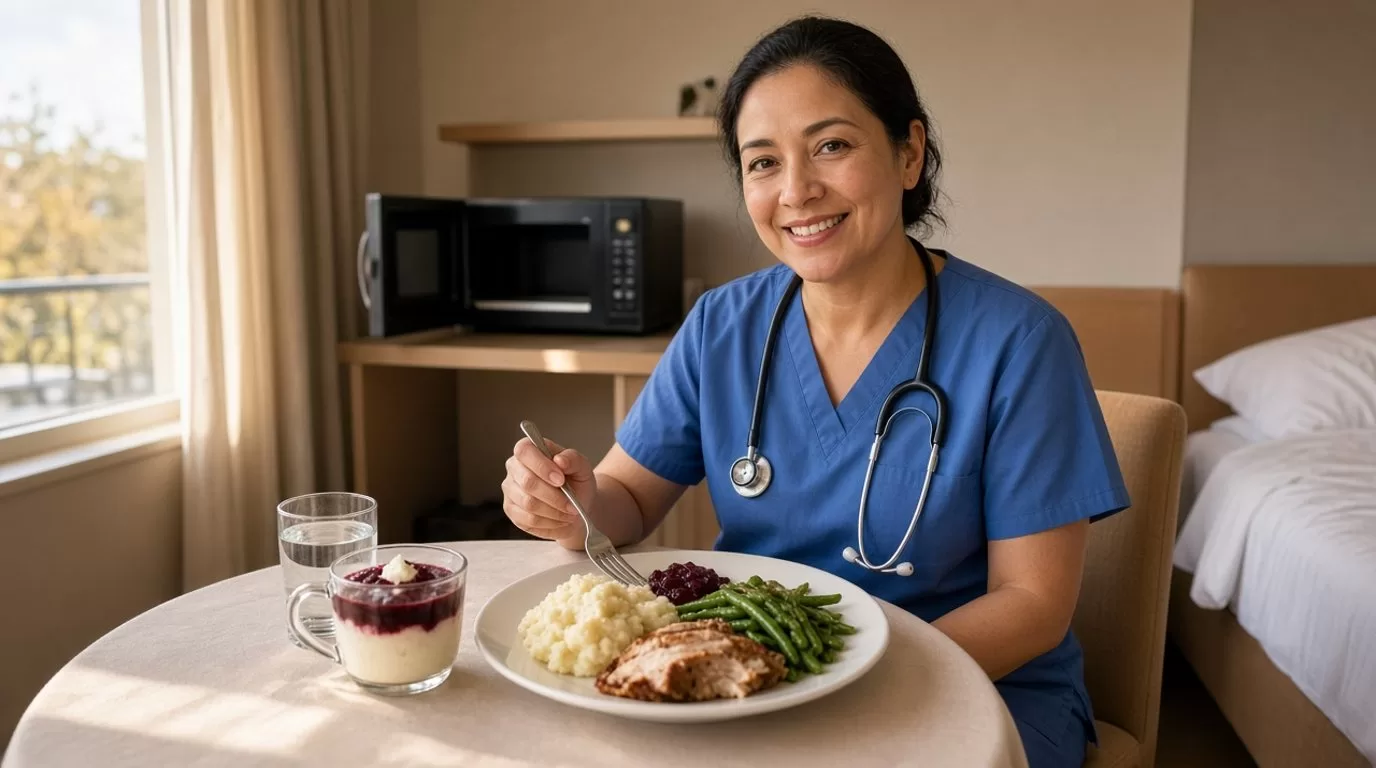
You picked up a thirteen-week contract that runs straight through the holidays. The pay was too good to pass up, the unit needed help, and honestly? You've worked enough Thanksgivings that the mystique wore off around 2019. But here you are: Thursday morning in a Comfort Inn outside Tucson, your shift doesn't start until seven PM, and you'd like to mark the day with something better than a Subway sandwich.
Your toolkit is limited. One microwave. No oven. No stovetop. A mini-fridge that may or may not keep lettuce crisp. And yet — with a quick grocery run, a couple of microwave-safe bowls, and about ninety minutes — you can pull off a legitimate Thanksgiving plate that doesn't come from a food court.
This is not a sad meal. This is a travel RN lifestyle hack, and it's genuinely good.
The Shopping List: One Grocery Stop, Minimal Waste
Hit a Safeway, Kroger, or Whole Foods on your way back from your Wednesday shift. You're aiming for single-serve or small-pack items that won't rot in your mini-fridge for the next eight weeks. Here's what goes in the cart:
- One bone-in turkey breast half, about 1.5 to 2 pounds (the deli counter will often sell these individually)
- One russet potato
- A small carton of chicken or vegetable broth
- Fresh green beans, about half a pound
- One can of cream of mushroom soup
- French-fried onions in the smallest canister you can find
- Instant stuffing mix, the kind in a box
- One can of whole-berry cranberry sauce
- Butter, the individually wrapped hotel-breakfast kind if you can grab a few extras, or just buy a stick
- Heavy cream or half-and-half, the smallest carton
- One slice of pumpkin pie from the bakery section, or grab a small jar of pumpkin purée, graham crackers, and whipped cream if you want to make a mug version
Total damage: under thirty dollars in most markets. And yes, you will eat the leftover stuffing mix and canned soup later in the week, so nothing goes to waste.
The Main Event: Microwave Turkey Breast That Actually Works
This is the piece everyone doubts, and it's the one that works better than you'd think. The USDA's food safety guidelines (available at https://www.fsis.usda.gov/) confirm that microwave cooking is perfectly safe for poultry as long as you hit an internal temp of 165°F and avoid cold spots by rotating and resting the meat.
Rinse your turkey breast and pat it dry with a paper towel. Place it in a microwave-safe dish — if your hotel room came with any kind of glass baking dish, perfect; otherwise, a deep microwave-safe bowl works. Add a half-cup of chicken broth to the bottom of the dish. This keeps the meat moist and prevents that rubbery texture.
Cover loosely with a microwave-safe plate or plastic wrap vented at one corner. Microwave on fifty-percent power. This is critical: full power will cook the edges into leather while the center stays raw. For a two-pound breast, you're looking at roughly fifteen minutes per pound at half power. So set your timer for fifteen minutes, check it, flip the breast over, and go another fifteen.
Use a meat thermometer if you packed one (and if you're doing travel nurse recipes in hotel rooms regularly, it's worth the five-dollar investment). Pull it at 165°F. Let it rest on the counter, still covered, for ten minutes. The temp will coast up a few degrees, the juices redistribute, and you'll have legitimately tender, properly cooked turkey that required zero oven space.
Mashed Potatoes in Eight Minutes
Peel your russet potato and chop it into half-inch cubes. Toss them in a microwave-safe mug or bowl with two tablespoons of water. Cover with a damp paper towel. Microwave on high for five minutes. Check for tenderness with a fork. If they're not quite soft, give them another minute or two.
Drain any remaining water. Add a tablespoon of butter (or two of those little foil packets from the breakfast bar), a splash of heavy cream, salt, and pepper. Mash with a fork. If you want them fluffier, add a bit more cream and whip them with the fork for another thirty seconds. They won't be as smooth as the KitchenAid-whipped version your mom makes, but they're real mashed potatoes, and they're hot.
Green Bean Casserole: Zero Stovetop Required
Trim your green beans and toss them in a microwave-safe bowl with a tablespoon of water. Cover and microwave for four minutes on high until they're tender-crisp. Drain. Stir in half the can of cream of mushroom soup (save the rest for another meal — it keeps in the mini-fridge for a week). Top with a handful of those french-fried onions.
Microwave uncovered for another two minutes until the soup is bubbly and the onions start to brown slightly around the edges. That's it. You just made the casserole that shows up at every Midwest Thanksgiving table, and you did it in a Courtyard by Marriott.
The Supporting Cast: Stuffing and Cranberry Sauce
Instant stuffing is your friend. Boil water in the microwave (two minutes for a cup of water in a microwave-safe mug), pour it over the stuffing mix in a bowl per the box directions, add the little butter packet, stir, cover, and let it sit for five minutes. Fluff with a fork. Done.
Cranberry sauce comes straight from the can. Slide it onto a small plate, slice it, and embrace the ridges. This is not the moment for homemade cranberry-orange relish. This is the moment for nostalgia-in-a-cylinder, and it tastes exactly right next to your turkey.
Dessert: Pumpkin Pie in a Mug (or Just Buy the Slice)
If you grabbed the bakery slice, you're done. Microwave it for twenty seconds to take the chill off, add a dollop of whipped cream from the can, and call it a win.
If you want to make a mug version: crush three graham crackers into crumbs and press them into the bottom of a microwave-safe mug. In a small bowl, whisk together three tablespoons of pumpkin purée, one tablespoon of sugar, a splash of heavy cream, a pinch of cinnamon, and a pinch of nutmeg. Pour over the graham cracker base. Microwave on fifty-percent power for ninety seconds. Let it cool for two minutes (it will firm up as it cools). Top with whipped cream. It's not a lattice-crust masterpiece, but it's warm, it's sweet, and it tastes like the holiday.
The Plate: Pull It All Together
Slice your rested turkey breast. Plate it with a scoop of mashed potatoes, a serving of green bean casserole, a mound of stuffing, and a few slices of cranberry sauce. If you want to get fancy, drizzle a little of the turkey broth from the cooking dish over the potatoes and stuffing.
Pour yourself a drink — whatever you packed, or a glass of wine from the grocery store run. Sit at the desk or the little round table by the window. Put on a movie or call someone you love. You just cooked a full Thanksgiving dinner in a hotel room with a microwave, and it tastes better than half the dry turkey and gluey mashed potatoes served at family tables across the country.
Why This Matters Beyond the Meal
Travel nurse recipes aren't just about food. They're about agency. You're working a holiday, far from home, in a city you didn't live in three months ago. The job is real, the patients need you, and the sacrifice is not trivial. But you also don't have to feel like a guest in your own life.
Cooking this meal — even a goofy, microwave-only version — is a way of saying: I'm still here. I still get to mark the day. The work matters, and so do I. It's the same reason you bring your own pillow on assignment, or find a coffee shop you go to twice a week, or learn the name of the front-desk person at your hotel. These small acts of normal life are what keep the travel RN lifestyle sustainable.
According to the Bureau of Labor Statistics' Occupational Outlook Handbook for registered nurses (https://www.bls.gov/ooh/healthcare/), the demand for RNs — including travel nurses — continues to grow as hospitals face staffing shortages and seek flexible workforce solutions. That means more of us will be spending holidays on the road, in hotels, picking up shifts in unfamiliar units. And that makes this kind of knowledge — how to carve out a moment of home when you're nowhere near it — genuinely valuable.
A Few Practical Tips for Hotel Thanksgiving Success
Timing matters. If you're working the evening shift, start cooking around two PM. Everything can be reheated quickly before you plate, so make the turkey and the sides in the early afternoon, then warm them up right before you eat. If you're working days and eating after your shift, prep what you can the night before (chop the potato, trim the green beans) so you're not standing in front of the microwave at eleven PM.
Invest in a set of nesting microwave-safe bowls. They're cheap, they stack in your car, and they make hotel cooking infinitely easier. A small cutting board and a decent knife are also worth packing. You can't do much with the plastic knife from the hotel breakfast bar.
Don't overthink it. This is not a competition. It's a decent meal on a hard day. If your mashed potatoes are lumpy, they're still mashed potatoes. If your turkey is a little dry, the gravy (or the broth you saved) fixes it. The goal is not perfection. The goal is not ordering DoorDash on Thanksgiving because you couldn't figure out an alternative.
After the Meal: What's Next
You've eaten. You've proven that hotel thanksgiving is not only possible but actually enjoyable. Now finish the pie, clean up your dishes in the bathroom sink, and get some rest before your shift. Tomorrow you're back on the unit, back in the rhythm of the assignment, back to the reason you took this contract in the first place.
And if you're between contracts or thinking about your next one, take a look at the openings in critical care, med-surg, or ER at Intuites Healthcare Staffing. We work with hospitals that need nurses during the holidays and understand what it takes to support you when you're far from home. Email contact@intuites.healthcare if you want to talk through winter or spring placements — we'll help you find something that works with your schedule and your life, microwave cooking skills and all.
Sources
Ready for your next travel nursing assignment?
Browse open travel nursing jobs across the US — weekly pay, stipends, and a recruiter who reads every application.