
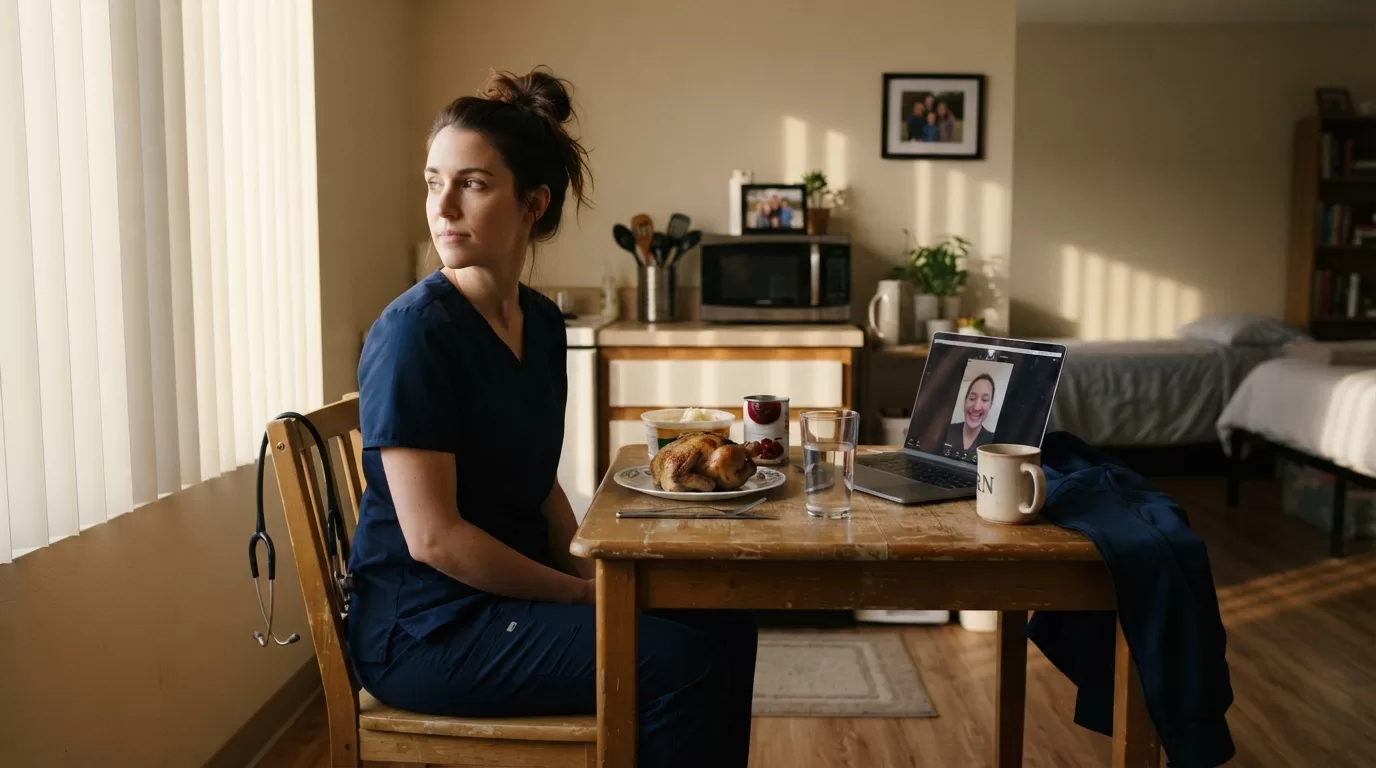
The first Thanksgiving you spend alone in a furnished rental apartment is a peculiar kind of quiet. You knew it was coming when you signed the contract — thirteen weeks starting mid-October, placing you squarely in a Houston medical center ICU for the entire holiday season. The pay differential was excellent. The housing stipend covered a clean one-bedroom near the Texas Medical Center. You told yourself it would be fine.
Then November arrives, and suddenly everyone at the nurses’ station is talking about their grandmother’s pecan pie recipe and which cousin is hosting this year. You smile and nod. You do not mention that your own family is gathering two thousand miles away in Oregon, or that your refrigerator currently contains string cheese, cold brew, and a questionable takeout container from four days ago.
This is the reality of travel nursing isolation that does not make it into the Instagram reels. It is not dramatic or tragic. It is just the specific loneliness of being competent, well-compensated, and eating grocery-store turkey alone while your phone lights up with family group-chat photos you were not there to be in.
The Weight of Holidays Away From Home
Travel nursing during major holidays is common. According to staffing data patterns observed across the industry, approximately forty percent of travel contracts include at least one major US holiday within the assignment period. Facilities need coverage. Someone has to work. The travelers who accept those contracts often do so intentionally — higher rates, critical-need bonuses, and the straightforward logic that if you are going to be away from home anyway, you might as well get paid well for it.
But logic does not prepare you for the emotional undertow of the actual day. You work your shift — a twelve-hour stretch in the ICU where Thanksgiving is just Thursday with slightly better cafeteria options. Your patients do not know it is a holiday, or they do and they are even more disoriented by it. Families visit in anxious clusters, smelling faintly of green bean casserole and guilt about leaving Grandma’s bedside to go eat.
You give meds. You chart. You troubleshoot a ventilator alarm. You are professional and present, because that is the job. Then your shift ends at seven-thirty in the evening, and you drive back to the apartment complex where you know exactly three people by sight and none by name.
What the Quiet Actually Feels Like
It is easy to romanticize solitude when you are not in it. The reality is more granular. You unlock the door to a space that still does not quite feel like yours even six weeks into the contract. The furniture came with the lease. The art on the walls is mass-produced and inoffensive. You have added a few things — a coffee mug from back home, a weighted blanket, a small photo frame — but the apartment resists personality the way hotel rooms do.
You heat up leftovers or order delivery. You scroll your phone and see everyone else’s tables, everyone else’s people. You are happy for them. You are also acutely aware of your own absence from your own family’s table, the empty chair that someone probably mentioned in a toast.
This is not self-pity. It is just the specific texture of travel RN life during holidays away from home. You made a choice that was smart for your career and your bank account, and the cost is this: sitting alone with your thoughts and your reheated plate while the rest of the country performs gratitude in groups.
Small Moments of Unexpected Connection
Here is what nobody tells you, though: the isolation is not total. It is punctuated by small, surprising moments of human contact that matter more than they would at any other time.
The nurse you have been working alongside for five weeks invites you to her sister’s house for dessert. You almost say no — too awkward, too intrusive — but you say yes instead, and you spend ninety minutes with strangers who treat you like someone who belongs at their table. You eat pumpkin pie. You hear stories about people you will never meet. You are grateful in a way that catches you off guard.
Or: the hospital cafeteria serves a full Thanksgiving spread during your dinner break, and the dietary staff has gone out of their way to make it nice. Real mashed potatoes. Actual turkey. Cranberry sauce from a can, yes, but served with the same care as everything else. You sit with two other travel nurses and a respiratory therapist who also pulled the holiday shift. Nobody complains. You all just eat, and the shared circumstance becomes its own kind of camaraderie.
Or: you join a local Facebook group for the city you are in — something like ‘Houston Newcomers’ or ‘Friendsgiving for Transplants’ — and someone posts an open invitation to a potluck for people who do not have family nearby. You bring store-bought rolls and meet a software engineer from Seattle, a teacher from Boston, and another travel nurse who is on her fourth assignment this year. You talk shop. You laugh. You leave two hours later feeling less alone than you have in weeks.
What Works When You Reach Out
Connection during travel nurse holidays does not happen by accident. It requires a small amount of bravery and a willingness to be the person who asks. Here is what seasoned travelers have learned works:
- Say yes to invitations even when they feel awkward or inconvenient, because the alternative is your apartment and your phone.
- Check hospital bulletin boards and unit group chats for holiday gatherings or potlucks — someone is always organizing something.
- Search Facebook for city-specific groups that host events for newcomers, solo travelers, or people far from family during holidays.
- Ask your recruiter if the agency has any local events or knows of other Intuites travelers in your area — sometimes a group text thread is all it takes.
- Volunteer for a few hours at a food bank or community meal service; being useful to others shifts the emotional weight in ways that are hard to explain but very real.
None of this erases the loneliness. But it interrupts it. And interruption, during a long assignment far from everyone you know, is enough.
Practical Strategies That Actually Help
Beyond seeking out connection, there are logistical and emotional strategies that make holidays away from home more bearable. These are small, concrete actions that veteran travel nurses recommend based on lived experience, not theory.
First: video calls are better when scheduled in advance. Spontaneous FaceTime during family dinner rarely works — everyone is distracted, the Wi-Fi is overloaded, and you end up feeling more peripheral than if you had not called at all. Instead, plan a dedicated call earlier in the day or the day after. Make it deliberate. Give it space. Your family will appreciate the structure, and you will not feel like an afterthought.
Second: pack at least one comfort item from home that has no practical purpose. A favorite mug. A specific blanket. A candle that smells like your childhood kitchen. These items do not solve loneliness, but they create a small sensory anchor in an unfamiliar space. On hard days, that matters more than it should.
Third: treat yourself to one genuinely nice meal, even if you are eating it alone. Order from the good restaurant. Buy the expensive cheese. Set the table properly. The act of caring for yourself with intention — rather than microwaving something over the sink — shifts the emotional register of the day from ‘endured’ to ‘observed.’
Managing Expectations and Emotions
It also helps to acknowledge, out loud or in writing, that this is hard. Toxic positivity does not serve you here. The truth is that spending Thanksgiving in a furnished rental while your family gathers without you is a loss, even if it is a temporary and well-compensated one. You are allowed to feel that loss without negating the good reasons you took the contract.
Journaling helps some people. Others prefer a phone call with one specific friend who understands travel nursing and will not try to fix your feelings. Some nurses find that a hard workout or a long walk in a new neighborhood provides enough physical release that the emotional weight becomes manageable.
The goal is not to talk yourself out of loneliness. The goal is to process it, acknowledge it, and then decide what you are going to do with the rest of your evening. Self-compassion and action, in that order.
What You Carry Forward
The strange gift of spending your first holiday alone in a travel apartment is that it recalibrates what ‘home’ means. You learn that holiday magic is not inherent to a location or a specific set of people. It is something you can create, in small ways, wherever you are.
You also learn resilience. Not the performative kind that shows up in motivational quotes, but the quiet, unglamorous kind that gets you through a twelve-hour shift and then a solitary evening without falling apart. That resilience becomes part of your professional identity. You carry it into future assignments. You carry it into hard shifts and difficult patients and all the other moments when you have to be your own anchor.
By your second or third travel nurse holiday, the isolation does not hit as hard. You know the rhythm. You know how to find your people, even temporarily. You know that the loneliness is real but finite, and that the contract will end, and that you will go home eventually with more money in your account and more confidence in your ability to handle hard things alone.
Building Your Own Traditions
Some travel nurses develop portable traditions that move with them from contract to contract. One nurse bakes the same pumpkin bread every Thanksgiving morning, no matter where she is. Another watches the same movie every year — a ritual that requires nothing but a laptop and an hour of time. Another writes a gratitude list specific to the current assignment: the coworker who made her laugh, the patient who said thank you, the apartment complex that has reliable hot water.
These traditions are small, private, and entirely within your control. They do not replace the big family gatherings you are missing. But they give you something to return to, year after year, that is yours alone. They make the solitude feel less like absence and more like a different kind of presence.
After the Holiday Ends
The day after Thanksgiving, the hospital returns to its regular rhythm. The decorations come down. The cafeteria goes back to its standard menu. Your unit is busy again with the usual weekday volume. Life continues, as it always does, and the holiday becomes just another shift you worked in just another city.
But something shifts internally, too. You have proven to yourself that you can do this — that you can be alone on a day that is built around togetherness and come out the other side intact. That proof matters. It becomes part of the narrative you tell yourself about who you are and what you are capable of.
You also gain perspective. The next time a contract overlaps with a holiday, you will know what to expect. You will pack the comfort items. You will schedule the video call. You will say yes to the coworker’s invitation. You will still feel lonely, probably, but you will also feel competent in your loneliness. You will know it is temporary. You will know you have survived it before.
And maybe, when you finally do make it home for a holiday — whether that is Christmas or next Thanksgiving or some random Tuesday in February — you will appreciate it differently. You will notice the noise and the chaos and the people in a way you did not before you spent time in the quiet.
If you are heading into your first travel nurse holiday or trying to decide whether to extend a contract through the season, trust that the isolation is real and also survivable. If you want to talk through upcoming assignments that might give you more control over your holiday schedule, email contact@intuites.healthcare with your specialty and preferred regions. Sometimes the right contract is the one that gets you home when it matters most. Sometimes it is the one that pays well enough to make the absence worth it. Either way, you get to decide.
Sources
Ready for your next travel nursing assignment?
Browse open travel nursing jobs across the US — weekly pay, stipends, and a recruiter who reads every application.