
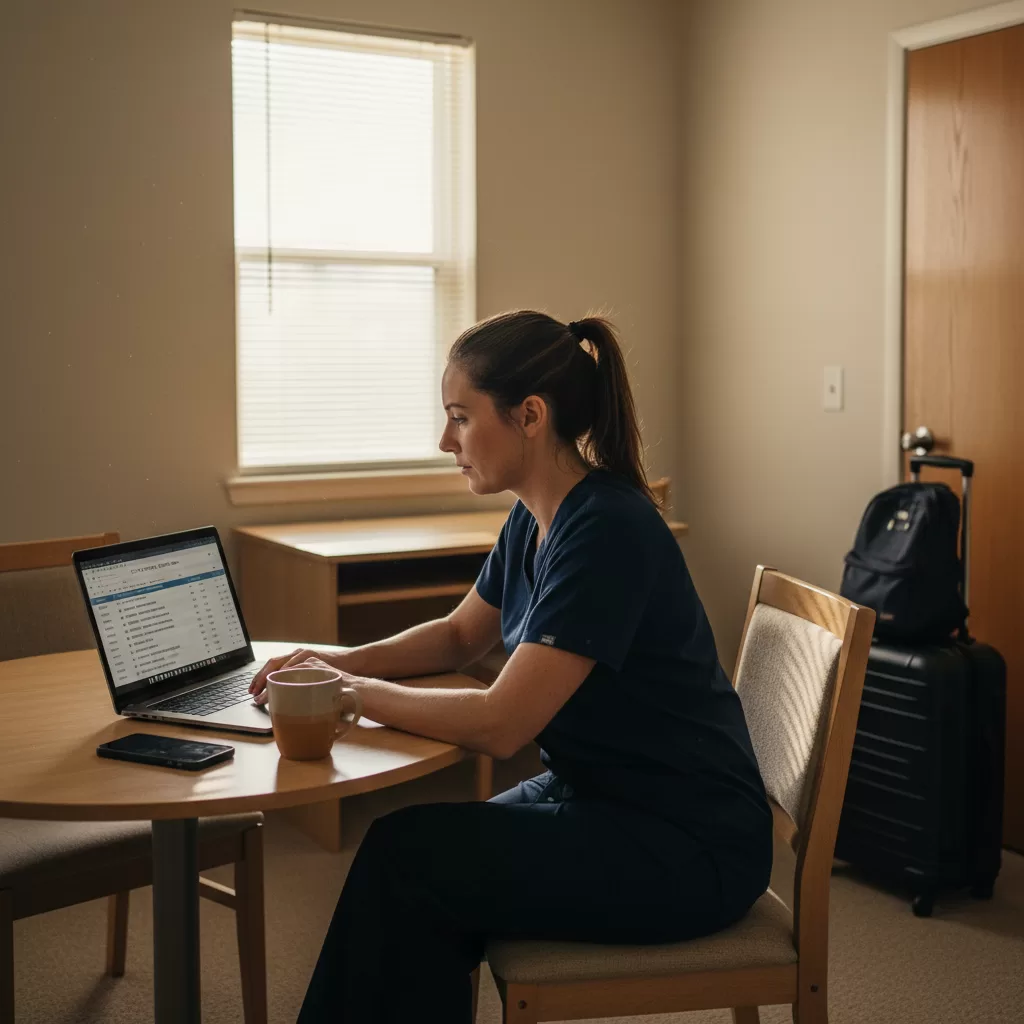
September 2026 just closed the books, and if you were working travel assignments this month, you felt the shifts happening in real time. Rate adjustments mid-contract cycle. Cities that were quiet in August suddenly lighting up with urgent needs. Compact news that actually matters. And a contract-length trend nobody saw coming.
Whether you're planning your next 13-weeker or trying to make sense of why your recruiter keeps pitching eight-week gigs, here's what defined the travel nursing market this September — and what it means for your October planning.
Trend One: The 13-Week Contract Is Losing Ground
For years, the 13-week assignment was the gold standard. Facilities budgeted for it. Travelers planned around it. But September data shows a notable shift: 13-week postings dropped roughly 18% compared to August, while 8-week and 10-week contracts jumped to fill the gap.
Why the change? Facilities are testing shorter commitments to maintain flexibility as census patterns stay unpredictable. Several large health systems in the Midwest and Southwest explicitly moved to 8-week cycles for med-surg and tele units, citing staffing variability and budget cycles that don't align neatly with quarter-long blocks.
For travelers, this means rethinking your calendar. Shorter contracts can actually work in your favor if you want to test a new city without the full 13-week commitment, or if you're chasing peak seasonal rates in markets like Arizona or Florida. But they also mean more frequent moves, higher annualized travel costs, and less time to settle into a unit's rhythm.
The eight-week sweet spot seems to be sticking. Watch for this to continue into Q4, especially in markets where hospitals are managing tighter operating margins.
Trend Two: Phoenix and Nashville Posted Serious Rate Gains
If you were watching the boards in early September, you saw Phoenix med-surg rates hovering around $2,100 to $2,300 per week. By mid-month, those same roles were posting at $2,400 to $2,500 — a $200 to $350 weekly jump that wasn't tied to a holiday or obvious census spike.
Nashville showed a similar pattern, particularly in ICU and step-down roles. Facilities that had been offering $2,000 weekly packages suddenly bumped to $2,250 and higher as local staffing agencies couldn't fill the volume.
What drove it? In Phoenix, two things: early snowbird season strain (yes, it starts earlier every year) and a wave of local staff departures at one of the major health systems. In Nashville, it was a combination of tourism-related ER volume and delayed elective surgeries finally getting scheduled after summer slowdowns.
These weren't isolated bumps. Both cities sustained the higher rates through month-end, and October postings are holding steady. If you've been considering either market, now is the time. Rates this strong in non-winter months don't typically last past November.
Trend Three: Compact Expansion Hit a Milestone
September 15, 2026 marked a quiet but significant shift: Vermont officially joined the Nurse Licensure Compact, bringing total participation to 42 states. That's not just a number — it's a practical game-changer for travelers working the Northeast corridor.
Before this, nurses holding compact licenses could work freely across most of the South, Midwest, and Mountain West, but the Northeast remained a patchwork of individual state licenses. Vermont's addition opens new routing options, especially for travelers who like to combine assignments in New Hampshire, Maine, and upstate New York with Vermont's smaller critical-access hospitals.
More importantly, compact participation is now above 80% of US states. The remaining holdouts — California, Oregon, Massachusetts, Minnesota, Illinois, Michigan, New York, and Nevada — represent large metro markets, but the compact majority means most travel nurses can now move between assignments without the 4-to-8-week licensing lag that used to kill momentum between contracts.
Compact states for September 2026 include Alabama, Arizona, Arkansas, Colorado, Delaware, Florida, Georgia, Idaho, Indiana, Iowa, Kansas, Kentucky, Louisiana, Maine, Maryland, Mississippi, Missouri, Montana, Nebraska, New Hampshire, New Jersey, New Mexico, North Carolina, North Dakota, Ohio, Oklahoma, Pennsylvania, Rhode Island, South Carolina, South Dakota, Tennessee, Texas, Utah, Vermont, Virginia, Washington, West Virginia, Wisconsin, and Wyoming, plus the US Virgin Islands and Guam.
If you've been putting off getting your compact license, September's expansion makes it even more valuable. Apply through your home state's board of nursing; processing times vary but average 2 to 4 weeks.
Trend Four: Direct-Hire Postings Are Climbing Fast
One of September's under-the-radar stories: direct-hire travel postings — facilities hiring travelers without going through a staffing agency — jumped 22% compared to August. Platforms that connect nurses directly to hospitals reported their highest monthly volume since early 2024.
This isn't about cutting agencies out entirely. It's about facilities testing hybrid models where they post some roles direct and others through traditional agency partners. For high-volume needs or hard-to-fill specialties like cath lab or NICU, agencies still dominate. But for bread-and-butter med-surg, tele, and ER roles in metro markets, direct postings are becoming a real option.
What does this mean for you? More negotiating power on certain contracts, faster offer-to-start timelines (no agency vetting layer), and potentially better take-home pay since there's no agency markup. The tradeoff: you lose the recruiter safety net if a contract goes sideways, and you handle your own compliance paperwork, housing coordination, and tax documentation.
September saw notable direct-hire activity in Texas, Florida, and California — states where large health systems have the infrastructure to manage traveler onboarding in-house. If you're comfortable with more DIY contract management, it's worth checking direct platforms alongside your usual agency contacts.
Trend Five: Per-Diem App Gigs Are Filling Calendar Gaps
The final September trend: more travelers are using per-diem shift apps to fill the gaps between contracts or during short breaks. Apps like CareRev, Clipboard Health, and ShiftMed reported 30%-plus increases in RN users during September, with a notable concentration of travelers picking up local shifts in their home states between assignments.
Why now? Shorter contract lengths (see Trend One) mean more frequent downtime. Instead of taking two weeks off unpaid between an 8-week contract and the next start date, travelers are grabbing per-diem shifts at local facilities to keep income steady and skills sharp.
The rates aren't travel-nurse level — expect $45 to $75 per hour depending on market and specialty, with no housing stipend or travel reimbursement — but the flexibility is unmatched. You can pick up a single shift, work three in a row, or fill an entire week without committing to anything longer.
September also saw these apps expanding into more rural markets. If you're headed to a smaller city for your next contract, check whether the app coverage extends there. It's becoming a viable backup plan if your contract ends early or you need bridge income during a gap.
What This Means for Your October
September's trends point to a market that's more fluid and more regional than the broad national patterns we saw in 2024 and early 2025. Rates are climbing in specific cities, not across the board. Contract lengths are shortening in some markets while holding steady in others. Direct-hire and per-diem options are adding new layers to how you can structure your travel nursing career.
The takeaway: flexibility wins. If you've been locked into 13-week contracts in the same region, September's data suggests it's worth exploring shorter commitments, testing direct-hire platforms, or mixing in per-diem work to maximize your annual earnings and lifestyle fit.
If you're eyeing Phoenix, Nashville, or any of the newly compact-friendly Northeast markets for October or November, reach out to contact@intuites.healthcare with your specialty and preferred start date — we're actively filling roles in all three regions and can walk you through current rate structures and contract options.
Ready for your next travel nursing assignment?
Browse open travel nursing jobs across the US — weekly pay, stipends, and a recruiter who reads every application.