
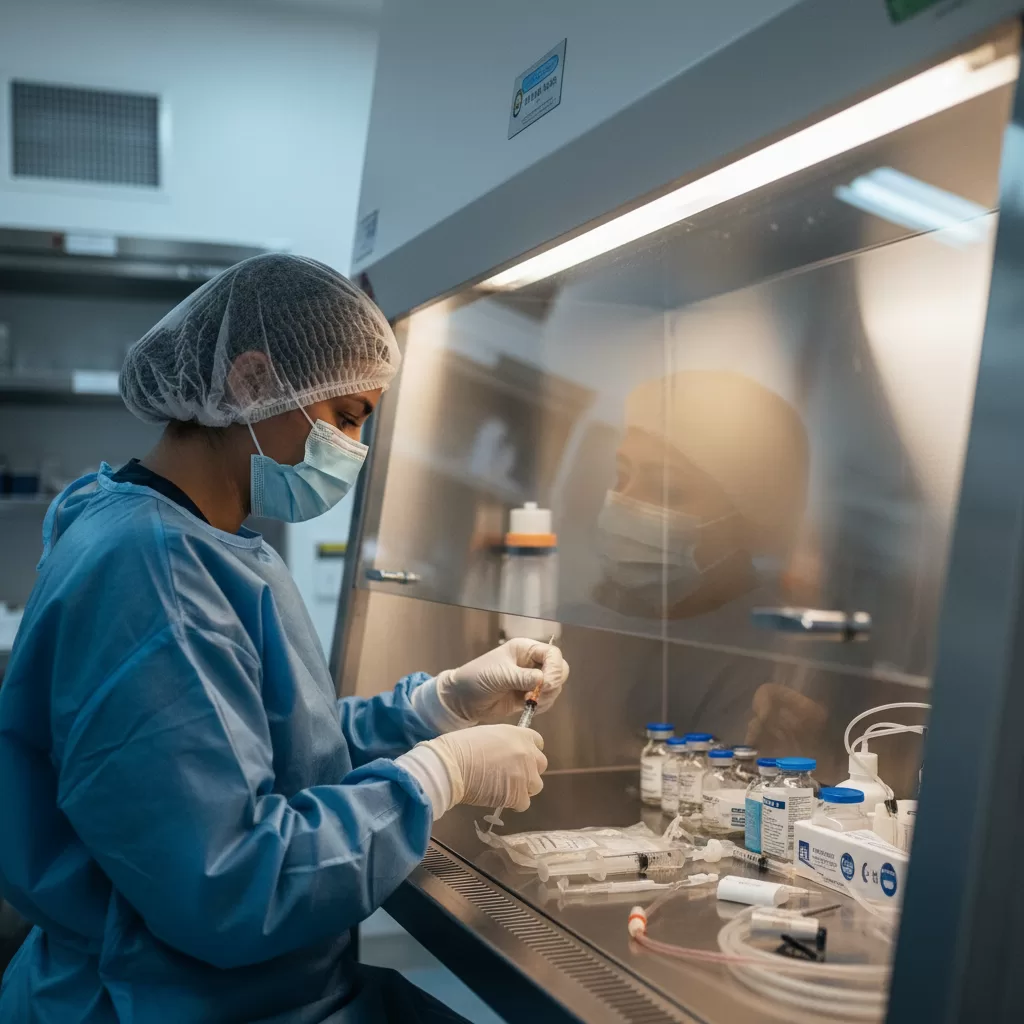
If you've been working retail or general pharmacy for a while, you've probably noticed something: the pharmacy techs working in hospital IV rooms and specialty compounding facilities often command higher pay and more predictable schedules. That's not a coincidence.
Sterile compounding — specifically, earning your USP 797 pharmacy tech credentials — is one of the clearest advancement pathways in pharmacy technology today. And unlike some healthcare certifications that feel like expensive resume padding, this one translates directly into measurable career benefits: higher hourly rates, access to hospital and specialty pharmacy roles, and marketability for travel assignments.
Let's walk through exactly how to add sterile compounding credentials to your profile, what the process actually involves, and how to find practicum sites that work with your schedule.
What USP 797 Certification Actually Means
USP 797 refers to the United States Pharmacopeia standards for sterile compounding — the strict protocols that govern how IV medications, chemotherapy, total parenteral nutrition, and other sterile preparations are safely made. When you earn a Compounding Sterile Preparations Technician (CSPT) credential, you're demonstrating mastery of these standards.
This isn't just theory. You'll learn:
- Aseptic technique and garbing procedures
- Laminar airflow hood operation and cleaning
- Beyond-use dating and stability calculations
- Hazardous drug handling (USP 800 overlap)
- Environmental monitoring and quality assurance
- Cleanroom behavior and contamination prevention
The credential is recognized nationwide and issued by the Pharmacy Technician Certification Board (PTCB). It sits alongside your CPhT but signals specialized competency that most retail-trained techs don't have.
The CSPT Pathway: Didactic + Practicum Requirements
To sit for the CSPT exam, you need to complete an ACPE-accredited sterile compounding training program. Here's the standard structure:
Didactic Component (40 Hours)
This is your classroom or online coursework covering USP 797 and USP 800 standards. Many programs offer asynchronous online modules you can complete around your current work schedule. Expect to spend 4-6 weeks on this portion if you're studying part-time.
Accredited programs include offerings from ASHP, Sterile Compounding Academy, and several community college pharmacy tech programs. Tuition ranges from $800 to $1,500 for the didactic piece alone.
Hands-On Practicum (80 Hours)
This is where most techs hit a logistical hurdle — and where strategic planning pays off. You need 80 hours of supervised, hands-on practice in an actual sterile compounding environment. That means access to a cleanroom, laminar flow hoods, and a preceptor who's already credentialed.
Three common practicum models:
- Hospital-affiliated programs: Some health systems partner with training programs and host practicum students in their IV rooms. These often convert to job offers.
- Employer-sponsored training: If you're already working at a facility with a compounding operation, ask if they'll provide practicum hours as part of your professional development.
- Independent externship sites: Specialty pharmacies, compounding pharmacies, and infusion centers sometimes accept extern students. Your training program can help coordinate placement.
The 80-hour requirement typically breaks into 2-3 weeks of full-time or 8-10 weeks of part-time shifts. Plan this during a time when you can reduce your regular work hours or negotiate a temporary schedule change.
What the Pay Impact Actually Looks Like
Let's talk numbers, because that's usually the first question: Is this worth the investment?
Based on 2025-2026 staffing data, pharmacy techs with sterile compounding credentials see an average hourly increase of $2 to $4 over their non-credentialed peers in the same market. In high-cost metro areas — think Boston, San Francisco, Seattle — that gap can stretch to $5 or more per hour.
For travel pharmacy tech contracts, USP 797 certification is often a prerequisite for hospital IV room assignments, which tend to offer the highest bill rates in the pharmacy tech travel market. A 13-week contract in a compounding role can mean $28-35/hour base pay plus housing stipends, compared to $22-26 for general retail travel roles.
Beyond the immediate pay bump, credentialed techs report better schedule stability (many IV rooms operate day shifts with minimal weekend rotation) and clearer pathways into lead tech or compounding supervisor roles.
Choosing an Accredited Training Program
Not all sterile compounding courses qualify you for the CSPT exam. You need an ACPE-accredited program that meets PTCB's educational requirements.
When comparing programs, ask:
- Is the didactic portion self-paced or cohort-based?
- Does tuition include practicum placement assistance, or are you responsible for finding your own site?
- What's the pass rate for graduates taking the CSPT exam?
- Are there additional costs for lab supplies, textbooks, or background checks?
- Does the program include USP 800 (hazardous drug handling) content, or is that separate?
Total program costs typically range from $1,200 to $2,500 when you include didactic tuition, practicum coordination, and exam fees. Some employers offer tuition reimbursement if you commit to staying in a compounding role for a set period — worth asking about before you pay out of pocket.
After Certification: Leveraging Your CSPT Credential
Once you pass the exam and add those four letters to your name badge, the next step is positioning yourself for the roles that value this skill set.
High-demand settings for sterile compounding techs include:
- Hospital IV rooms and central pharmacies
- Oncology and infusion centers
- Specialty pharmacies (hemophilia, transplant, rare disease)
- Compounding pharmacies (both sterile and non-sterile)
- Home infusion providers
- Clinical trial pharmacies
If you're currently in a retail role, your cleanest transition is often through PRN or part-time hospital work while you build compounding experience. Many facilities prefer to hire sterile compounding techs who've logged at least six months of real-world IV room time, even if it started as weekend-only shifts.
For techs open to travel, sterile compounding credentials unlock assignments in markets that don't typically hire non-specialized travelers. Contracts in academic medical centers, transplant hospitals, and large oncology networks frequently require USP 797 certification as a baseline.
Your Next Step
If you're ready to explore how sterile compounding credentials fit into your career trajectory — or if you'd like insight into which markets are actively hiring CSPT-credentialed techs for travel roles — reach out to our allied health team at contact@intuites.healthcare with 'USP 797 pathway' in the subject line.
Ready for your next allied health assignment?
Browse open allied health jobs across the US — weekly pay, stipends, and a recruiter who reads every application.