
Virtual nursing has moved from pilot programs to permanent workforce strategy. In 2026, more than 140 U.S. health systems have embedded remote RNs into their care models — and they are hiring right now. If you have been watching telehealth from the sidelines, this is the year the market matured into real jobs with real paychecks.
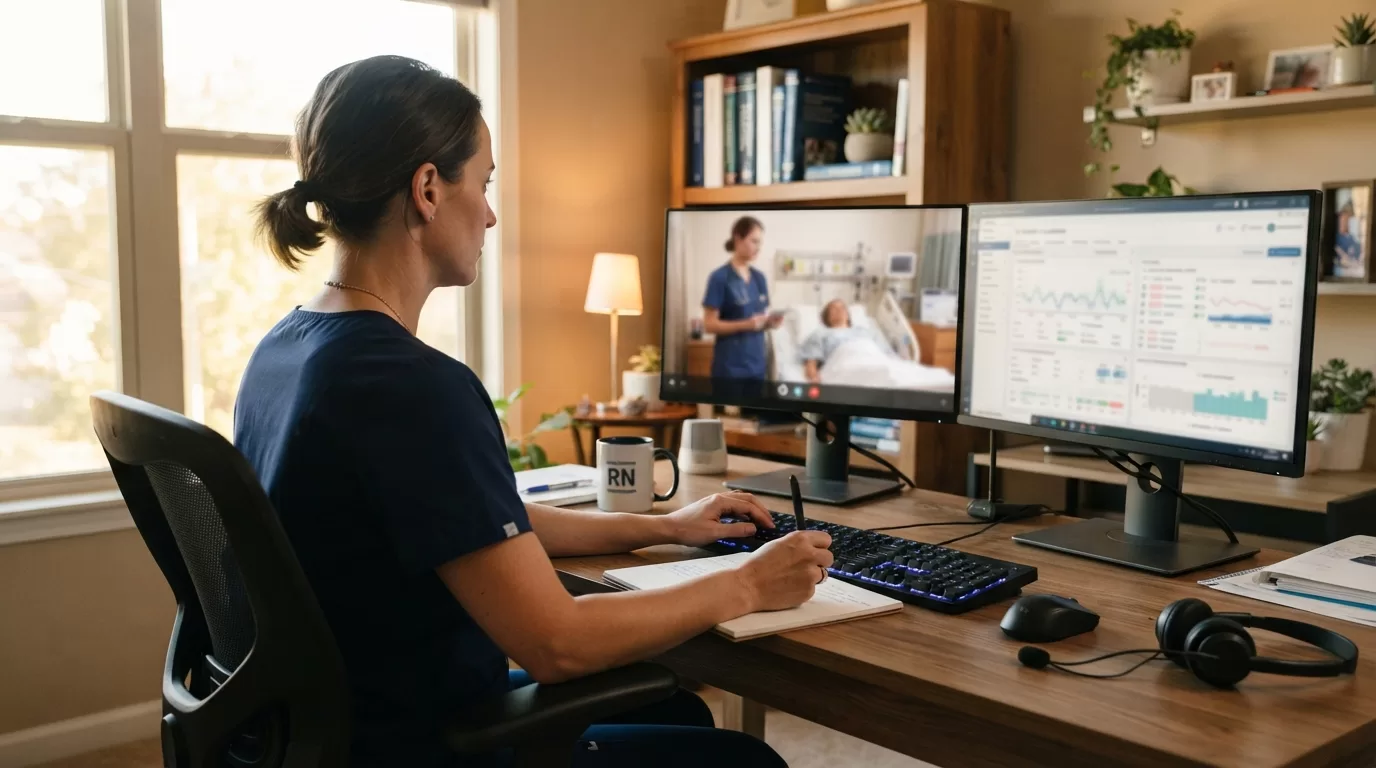
The model is simple: a virtual nurse supports bedside clinicians through real-time video, handling admission assessments, discharge education, care coordination, and documentation. The bedside nurse stays hands-on with physical tasks. The virtual nurse brings clinical expertise without the commute. It is a fundamentally different role from telephone triage or case management, and employers are paying accordingly.
Here is who is hiring, what they are offering, and what you need to land one of these positions in the fourth quarter of 2026.
Which Health Systems Are Hiring Virtual Nurses Right Now
Banner Health leads the pack. The Phoenix-based system announced in September 2026 that it will add more than 200 virtual RN positions across Arizona, Colorado, and Nebraska by year-end. These roles support medical-surgical, telemetry, and progressive care units during day and night shifts. Banner requires Arizona or compact-state licensure and at least two years of acute care experience.
Mayo Clinic expanded its virtual nursing program in August 2026, adding 75 remote positions based in Minnesota and Florida. Mayo is offering a $5,000 sign-on bonus for virtual RNs who start before December 31, 2026. The roles focus on admission and discharge processes, allowing bedside nurses to spend more time on direct patient care. Mayo prefers candidates with med-surg or ICU backgrounds and requires Minnesota or compact licensure.
Advocate Health — the newly merged system combining Advocate Aurora and Atrium Health — announced 120 virtual RN openings in October 2026. Positions are remote but tied to facilities in Illinois, Wisconsin, and North Carolina. Advocate is hiring for both full-time and part-time shifts, including weekend-only options. Pay ranges from $33 to $42 per hour depending on experience and location.
Cleveland Clinic quietly scaled its virtual nursing team to more than 300 RNs in 2026, according to an October interview with the system’s chief nursing officer in Modern Healthcare. The clinic hires virtual nurses on a direct-employee basis, not contract. Most positions require Ohio licensure or compact status and include full benefits. Cleveland Clinic does not advertise these roles on general job boards; they appear only on the organization’s career portal.
HCA Healthcare piloted virtual nursing in 2023 and has since rolled out the model to more than 60 hospitals across its network. In fall 2026, HCA posted openings in Tennessee, Florida, Texas, and Nevada. The company uses a hub model: virtual nurses work from centralized offices rather than home. Pay starts around $30 per hour for nurses with three years of experience.
What Virtual Nurse Jobs Actually Pay in 2026
Compensation varies by system, geography, and whether the role is salaried or hourly. According to data published by the Bureau of Labor Statistics in May 2026, the median annual wage for registered nurses working in “management of companies and enterprises” — the category that includes many virtual and remote nursing roles — was $79,840. That figure sits slightly above the overall RN median of $77,600.
Here is what major employers are advertising for virtual RN positions as of October 2026:
- Banner Health: $68,000 to $88,000 annually, depending on experience and shift differential
- Mayo Clinic: $72,000 to $92,000 annually, plus the $5,000 sign-on bonus through year-end
- Advocate Health: $33 to $42 per hour, translating to roughly $68,640 to $87,360 for full-time work
- Cleveland Clinic: $70,000 to $85,000 annually for experienced RNs with specialty backgrounds
- HCA Healthcare: $30 to $38 per hour, or about $62,400 to $79,040 annually
These figures do not include shift differentials, weekend premiums, or benefits. Most virtual nursing roles qualify for the same health insurance, retirement matching, and tuition reimbursement programs available to bedside staff. Some systems also offer home-office stipends — typically $500 to $1,000 — to cover internet upgrades, ergonomic chairs, or monitor purchases.
It is worth noting that virtual RN pay generally sits below travel nursing rates but above many permanent staff positions. If you are a travel RN earning $2,200 per week on a med-surg contract, you are pulling in roughly $114,400 annually before taxes and housing stipends. A virtual nursing role will not match that take-home, but it eliminates travel, housing logistics, and the 13-week contract churn.
What Qualifications and Technology You Need
Nearly every virtual nursing job posting in 2026 lists the same three baseline requirements: an active RN license, at least two years of acute care experience, and reliable high-speed internet. Beyond that, employers look for specific clinical and technical skills.
Licensure. Multi-state compact licensure makes you a stronger candidate. As of October 2026, 41 states participate in the Nurse Licensure Compact, according to the National Council of State Boards of Nursing. If you hold a compact license, you can practice in any member state without applying for additional credentials. Some systems — like Banner and Advocate — explicitly prefer compact-licensed nurses because it allows them to deploy virtual staff across multiple facilities in different states.
Clinical background. Med-surg and telemetry experience dominate the job descriptions. ICU experience is valued but not always required. Specialty backgrounds in oncology, cardiac care, or neurology can set you apart if the health system runs dedicated virtual programs in those service lines. Employers want nurses who can think critically during remote assessments and communicate clearly with bedside teams.
Technology requirements. You will need a dedicated workspace with a door, dual monitors (most employers require two screens), a headset with noise cancellation, and a webcam. Internet speed must meet minimum thresholds — typically 25 Mbps download and 5 Mbps upload. Some systems provide laptops and docking stations; others expect you to use your own equipment and reimburse you through a home-office allowance.
Training programs. Most health systems offer a 4- to 6-week onboarding program for new virtual nurses. You will learn the organization’s EHR platform, video communication tools, and virtual workflow protocols. Expect shadowing shifts where you observe experienced virtual RNs, followed by precepted shifts where you take the lead under supervision. Cleveland Clinic and Mayo both require competency sign-offs before you work independently.
How Virtual Nursing Fits Into Your Career Path
Virtual nursing is not a stepping stone or a fallback. It is a distinct clinical role with its own skill set and career trajectory. Some nurses move into virtual positions after bedside burnout. Others see it as a way to apply clinical expertise while gaining work-life balance. A few health systems are building leadership pipelines specifically for virtual nurse managers and educators.
If you are a travel nurse considering a shift to permanent work, virtual nursing offers middle ground. You keep the flexibility of remote work without the Housing and Urban Development stipend calculations, the 50-mile radius rules, or the tax-home headaches that come with travel contracts. You also gain job security and benefits that travel roles typically do not include.
For nurses with caregiving responsibilities — whether that is young children, aging parents, or a spouse with health needs — virtual nursing eliminates the commute and allows you to build your work schedule around home obligations. Many systems offer part-time and weekend-only options that simply do not exist in traditional bedside roles.
That said, virtual nursing is not easier than bedside work. You will manage multiple patient interactions simultaneously, troubleshoot technology failures in real time, and communicate complex clinical information without being in the room. The cognitive load is high. The pace is fast. And you will not have the immediate physical presence of a charge nurse or a physician when a situation escalates.
Where to Find Open Virtual RN Positions
Most virtual nurse jobs do not appear on general staffing platforms or job boards. Health systems post these roles directly on their career portals, and they fill quickly. Here is where to look:
- Go directly to the careers page of the health systems listed above. Search terms like “virtual nurse,” “telehealthnurse,” or “remote RN” will surface active postings.
- Set up job alerts on the American Nurses Association career center, filtering for remote or telehealth roles.
- Check LinkedIn for virtual nursing openings. Many nurse recruiters at large systems post there before listings go live on corporate sites.
- Join virtual nursing groups on Facebook or nursing forums. Nurses already in these roles often share when their employers open new requisitions.
If you are an Intuites candidate, email contact@intuites.healthcare with “virtual RN openings” in the subject line and we will connect you with health systems actively hiring for remote nursing positions that match your license and experience.
Sources
Ready for your next nursing assignment?
Browse open nursing jobs across the US — weekly pay, stipends, and a recruiter who reads every application.