
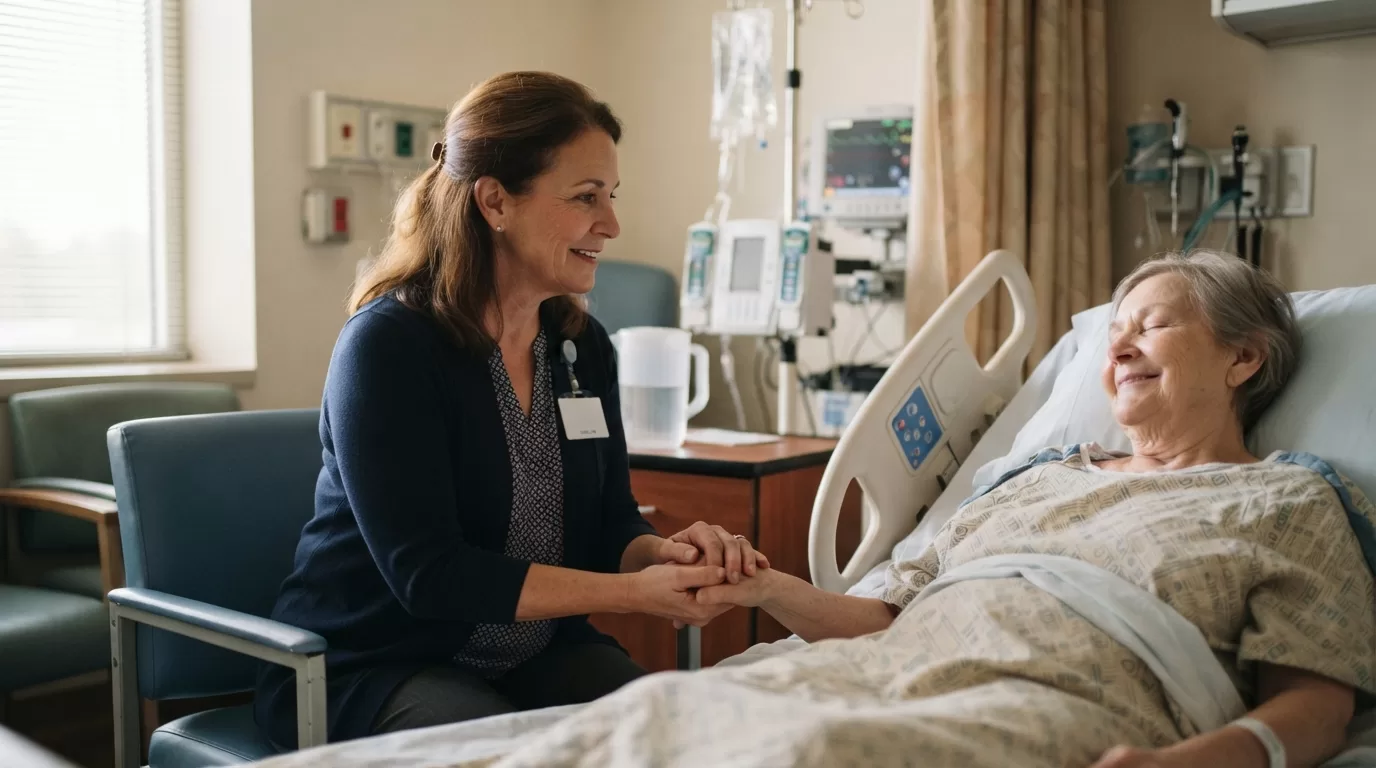
You were four hours into a twelve-hour shift when the daughter cornered you at the nurses’ station. Her mother — your patient in 412 — wasn’t eating, wasn’t speaking, and the daughter needed someone to explain what “comfort measures” actually meant. You had six other patients, two discharges before lunch, and a post-op admission already in the ER waiting for a bed.
So you did what any good clinician does: you paged the chaplain.
Two hours later, when you finally made it back to 412 with the noon meds, the room felt different. Quieter. The daughter was crying, but softly now, and your patient’s hand rested in hers. The chaplain — a retired teacher who volunteers three afternoons a week — nodded at you from the corner chair and slipped out without fanfare. That’s the work most of us never see. The interdisciplinary care that doesn’t show up on a flow sheet but changes everything about how a family experiences the hardest day of their lives.
The Clinical Gap That Chaplains Fill
Healthcare training teaches us to stabilize, treat, and discharge. We learn pharmacology and anatomy and evidence-based protocols. What we don’t always learn is how to sit with someone who’s terrified, or how to hold space for grief when there’s nothing left to fix.
That’s where the hospital chaplain steps in — and not just for end of life care, though that’s often when their presence becomes most visible. According to The Joint Commission’s standards for spiritual care, accredited hospitals must address patients’ spiritual and emotional needs as part of comprehensive treatment. Chaplains are trained in clinical pastoral education, which means they understand medical language, interdisciplinary care workflows, and how to navigate complex family dynamics under pressure.
Here’s what many clinicians miss: chaplains don’t proselytize. They don’t arrive with a script or an agenda. A well-trained hospital chaplain meets patients exactly where they are — atheist, Buddhist, evangelical Christian, uncertain — and offers presence, not persuasion. They’re there to listen when you don’t have the fifteen minutes it takes to hear about a patient’s estranged son, or the guilt they carry about a decades-old decision, or the question they’re too embarrassed to ask their doctor.
When your patient in 412 stopped talking, it wasn’t because she needed another medication adjustment. She needed permission to let go. That’s a conversation you can’t have while hanging a new IV bag and answering three call lights. But the chaplain could. And did.
What Interdisciplinary Care Actually Looks Like
Interdisciplinary care is more than a buzzword on a hospital website. Done right, it means every discipline — nursing, pharmacy, social work, physical therapy, and yes, spiritual care — contributes to the patient’s treatment plan. The American Nurses Association recognizes that holistic care includes addressing spiritual distress, which can manifest as anxiety, refusal of treatment, or requests to “just go home.”
In practice, that looks like:
- Including chaplaincy in morning huddles or interdisciplinary rounds, especially on oncology, palliative, and ICU units
- Flagging patients who express existential concerns (“What’s the point?” or “I’m ready”) for a chaplain consult, not just a psych eval
- Documenting spiritual care visits in the patient’s chart so the whole team knows that work has been done
- Letting the chaplain brief you before a family meeting so you understand what emotional ground has already been covered
One travel nurse who worked a thirteen-week ICU contract in North Carolina told us she didn’t understand the chaplain’s role until she watched one facilitate a withdrawal-of-care conversation. The family had been arguing for days — some wanted “everything done,” others wanted to honor the patient’s advance directive. The chaplain didn’t make the medical decision, but she translated the clinical language into plain terms, acknowledged everyone’s fear, and helped the family arrive at consensus. The attending signed the order. The nurse carried it out. But the chaplain did the emotional labor that made it possible.
Why End of Life Care Needs More Than a Protocol
According to the Centers for Disease Control and Prevention, roughly 2.8 million people die in the United States each year, and a significant percentage of those deaths occur in hospitals or skilled nursing facilities. Each one of those deaths involves not just a patient, but a care team and a circle of loved ones navigating shock, relief, guilt, or all three at once.
Clinical guidelines tell us when to start comfort measures. They don’t tell us what to say when a husband asks if his wife knew he was there at the end, or when a patient asks you point-blank if you think there’s anything after this.
Chaplains are trained for exactly those moments. Their clinical pastoral education includes hundreds of supervised hours learning how to be present with suffering without trying to fix it, how to ask open-ended questions that let people process grief out loud, and how to recognize when someone needs a referral to social work, ethics, or behavioral health.
They also know how to work fast. In a busy unit, the chaplain might spend ninety seconds at a bedside — just long enough to make eye contact, acknowledge fear, and offer to come back. That’s often enough. Patients remember who showed up, even briefly, when they were scared.
The Volunteer You Didn’t Know You Could Call
Not every hospital employs a full-time chaplain. Many rely on a mix of paid staff and trained volunteers, especially in community hospitals and rural facilities. These volunteers often have prior careers in teaching, counseling, or ministry, and they complete the same clinical pastoral education requirements as paid chaplains.
What they bring to the floor is time — the one resource that’s always in short supply. They can sit with a confused patient while you call the pharmacy. They can walk with a family to the cafeteria and answer the questions they were too overwhelmed to ask during rounds. They can pray if asked, or simply hold a hand if that’s what’s needed.
You don’t need a doctor’s order to request a chaplain visit. In most facilities, any member of the care team — nurse, tech, therapist — can put in a consult. If your patient mentions feeling alone, or if a family member looks lost, that’s enough. Page the chaplain. Let them do the work they’re trained for.
How to Make Spiritual Care Part of the Plan
If you’ve never worked closely with chaplaincy services, start small. Introduce yourself to the chaplain who covers your unit. Ask them how they prefer to be contacted and what information helps them prioritize visits. Most chaplains appreciate a quick text or page that includes the patient’s room number, a one-sentence summary of the situation (“family struggling with DNR decision” or “patient expressing fear about surgery”), and whether it’s urgent or routine.
In your documentation, note when a chaplain has visited and what the patient or family expressed. This isn’t about recording the content of a private spiritual conversation — it’s about flagging that emotional or existential distress has been addressed as part of holistic patient support. If the chaplain identifies a need for additional resources — maybe the patient has no advance directive, or the family needs help with funeral planning — loop in social work.
During interdisciplinary rounds, mention the chaplain’s involvement the same way you’d mention PT’s progress note or the pharmacist’s med rec. It signals to the whole team that this patient’s care includes more than vitals and lab values.
And if you’re the one who’s struggling — maybe you just lost a patient you’d been caring for all week, or you’re carrying something heavy from a previous shift — chaplains are available to staff, too. They won’t fix the staffing ratio or the broken supply chain, but they’ll listen. Sometimes that’s enough to get you through the next four hours.
What That Quiet Presence Actually Accomplished
Back in room 412, you didn’t see what happened during those two hours. You don’t know that the chaplain asked the daughter to tell her one story about her mother — just one — and that the daughter talked for twenty minutes about a road trip they took in 1987. You don’t know that your patient squeezed her daughter’s hand halfway through the story, or that the chaplain helped the daughter understand that her mother could still hear her, even if she couldn’t respond.
What you do know is that when you returned with the medications, the room felt peaceful. The daughter wasn’t angry anymore. Your patient’s breathing had slowed. And when the family made the decision to transition to hospice the next morning, there was no conflict, no second-guessing, no frantic calls to distant relatives demanding a different plan.
That’s what good interdisciplinary care does. The chaplain didn’t replace your clinical expertise. She complemented it. She did the work you didn’t have time for, using skills you weren’t trained in, and the patient’s final days were gentler because of it.
If you’re working in a facility with an active chaplaincy program, take a moment this week to introduce yourself. If you’re on a travel contract and you’re not sure whether chaplain services are available, ask your unit manager. And the next time you have a patient who’s scared, or a family who’s stuck, or a situation where the clinical plan is clear but the emotional path forward isn’t — make the call. Let the chaplain do what you couldn’t. That’s not a failure on your part. That’s interdisciplinary care working exactly the way it should. If you’re looking for your next contract in a facility that values the whole care team — clinical, emotional, and spiritual — email contact@intuites.healthcare and let us know what kind of supportive environment you’re looking for.
Sources
Ready for your next healthcare assignment?
Browse open healthcare jobs across the US — weekly pay, stipends, and a recruiter who reads every application.