I saw her name on the schedule at 2:47 on a Thursday afternoon. Mrs. Patricia Rowland. CT chest with contrast, pulmonary embolism protocol. The ordering physician had flagged it STAT.
My hands stopped moving across the keyboard. Mrs. Rowland taught junior-year English at the high school I attended fifteen years ago. She was the teacher who made me believe I could do hard things — who wrote the recommendation letter that got me into my radiologic technology program when my GPA was borderline and my confidence was worse.
And now she was my patient.
The Moment You Recognize the Name
According to the Bureau of Labor Statistics, there are approximately 208,000 radiologic and MRI technologists working in the United States as of 2024. We scan thousands of patients over the course of a career. Most are strangers. Some become familiar faces if they return for serial imaging. A handful are people we know outside the hospital walls.
When that happens, the work changes shape.
I had about twelve minutes before transport brought Mrs. Rowland down from the ED. Twelve minutes to move from the shock of seeing her name to the clarity I would need to do my job well. I pulled her chart. Acute onset shortness of breath, tachycardia, recent flight from Denver. Classic PE risk factors. The ED attending wanted answers fast.
I told my lead tech. Not because I needed permission to scan her — I did not — but because naming the situation out loud made it real and gave me a witness. She nodded. ‘Do you need someone else to take it?’ she asked. I thought about it. Then I said no.
What the Books Do Not Teach You About Imaging Patient Care
Radiologic technology programs teach you physics and positioning and radiation safety. They teach you how to calculate contrast volumes and troubleshoot scanner errors and recognize artifacts. You learn ALARA principles and how to calm a claustrophobic patient and where to place the bucky for a lateral chest.
What they do not teach you — because they cannot — is how it feels to position someone who once positioned you for success.
Mrs. Rowland came through the doors on a gurney, oxygen cannula in place, looking smaller than I remembered. Her hair had gone mostly gray. She saw me and smiled, confused at first, then recognition. ‘Oh my goodness,’ she said. ‘You’re — ’
‘Hi, Mrs. Rowland,’ I said. ‘I’m going to be your CT tech today.’
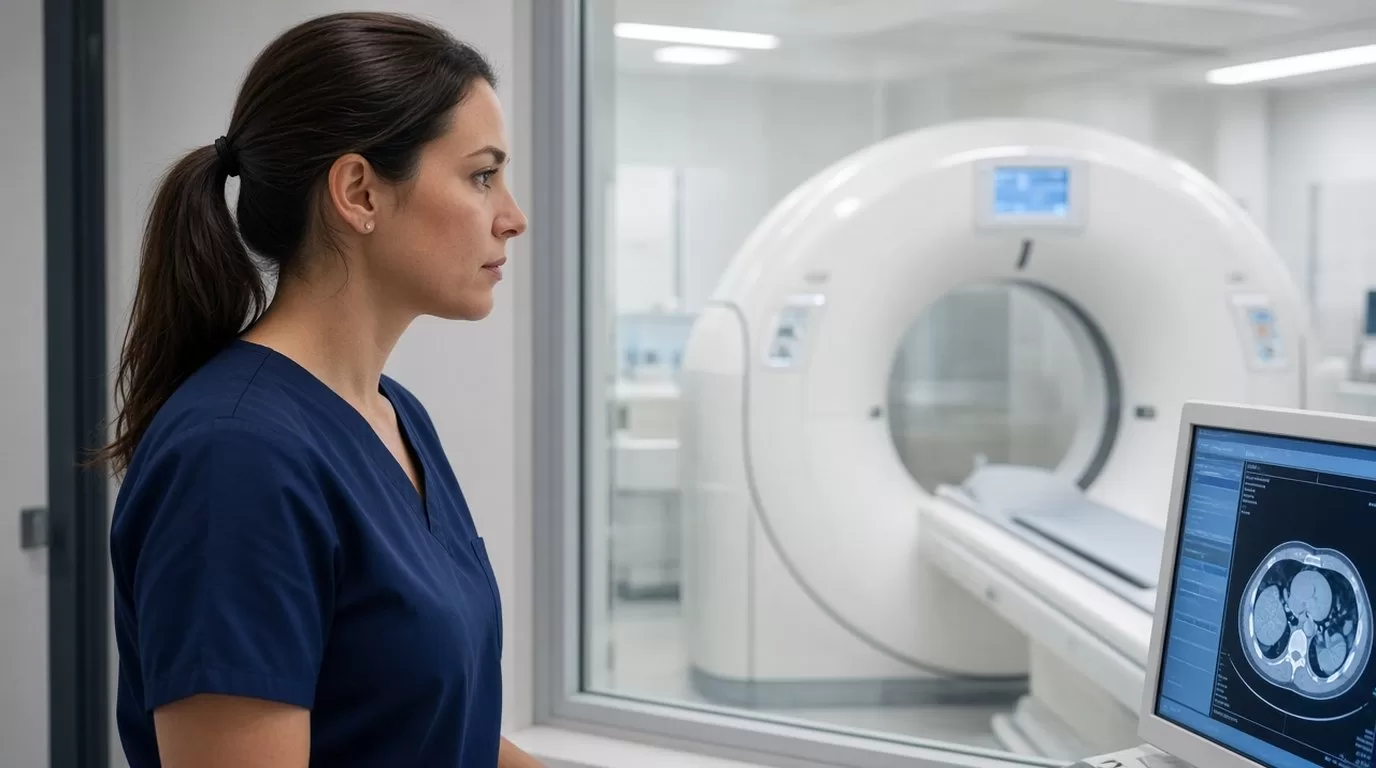
I kept my voice steady and professional. I explained the scan exactly the way I would explain it to any patient: the IV contrast, the warm flush sensation, the breath-hold instructions, the donut-shaped machine. I asked about allergies and kidney function and prior reactions. I confirmed her identity with two identifiers. I did everything correctly because correctness was the only scaffold I had.
She kept looking at me like she wanted to say something more, but I was already moving — transferring her to the table, positioning the IV, prepping the power injector. I was kind, but I was also controlled. I needed the boundaries.
The Professional Distance That Protects You Both
There is a concept in healthcare ethics called dual relationships — when a clinician has both a professional role and a personal connection to a patient. It is studied most often in mental health and primary care settings, but it applies to imaging too. The American Registry of Radiologic Technologists Code of Ethics directs us to ‘act as a patient advocate’ and to ‘respect patient confidentiality.’ Those duties do not change when the patient is someone you know.
In fact, they intensify.
Here is what I know now that I did not know in that scanning room: professional distance is not coldness. It is respect. It is the gift of letting Mrs. Rowland be a patient instead of my former teacher. It meant she did not have to perform strength or gratitude or remember-me-fondly. She could just be scared and short of breath and waiting for an answer.
I stepped into the control room and initiated the scan. The table moved. The gantry hummed. I watched her on the monitor, watched her chest rise and fall, watched the contrast bolus tracking software calculate the delay. Then: ‘Take a deep breath in and hold it.’
Twenty-two seconds. The images streamed across my screen in real time.
When You See What You Did Not Want to See
There it was. A saddle embolus at the bifurcation of the main pulmonary artery, with extension into both the right and left branches. Large. Acute. Life-threatening if untreated.
I am not a radiologist. I do not make diagnoses. But I have been doing this long enough to recognize the images that need a phone call, not just a report in the queue. I paged the reading radiologist immediately, then called the ED attending directly. Mrs. Rowland was still on my table when I heard the overhead code blue announcement two floors up — unrelated, but it made my hands shake anyway.
The ED attending arrived in four minutes. I gave him the images. He looked, nodded, started making calls. I helped Mrs. Rowland sit up slowly, gave her water, told her the doctor would be in soon to talk with her. She thanked me. She said, ‘You were always so bright. I knew you’d do something important.’
I smiled and said something I do not remember now. Then I walked her back to the ED and returned to my control room and sat down and felt the weight of the whole afternoon in my chest.
The Reflection That Comes After
Mrs. Rowland was admitted. She was started on anticoagulation. Three days later, she was discharged home with a care plan and outpatient follow-up. I know this because I checked her chart — once, briefly, the way you check to see if a story you started has an ending you can live with.
I did not visit her on the floor. I did not send a card. Those would have been kind gestures, but they would have crossed the line I had worked so hard to hold. She was my patient for twenty-two minutes. In that space, I gave her my full skill and my full attention and my adherence to every protocol that keeps imaging patient care safe and accurate.
That was the gift I had to give.
Here is what I learned, and what I carry forward into every shift now:
- Emotional reactions to patients are normal, especially when personal history is involved. Acknowledge them to yourself or a trusted colleague, but do not let them override your protocols.
- Professional boundaries are not walls — they are containers. They let you be fully present without becoming overwhelmed or compromised.
- You cannot un-see what the scan shows. Your job is to acquire excellent images and communicate findings appropriately, not to absorb the diagnosis as your own emotional burden.
- Familiar patients may worry about privacy more than strangers do. Reassure them explicitly that their information is protected under HIPAA and that you treat every patient with the same confidentiality standards.
- Sometimes the most compassionate thing you can do is to stay in your role. Mrs. Rowland did not need me to reminisce or cry with her. She needed me to be competent, calm, and thorough.
The American Society of Radiologic Technologists emphasizes that patient-centered care includes emotional safety as well as physical safety. That means managing our own responses so that patients do not have to manage them for us.
What This Means for Your Practice
If you work in imaging long enough, you will scan someone you know. Maybe it is a neighbor, a friend’s parent, a coworker from another department, or — like me — a person who shaped your life in some earlier chapter. When it happens, here is what helps:
- Tell your charge nurse or lead tech before the scan if possible. You do not need permission, but you do need a witness and a backup plan if the emotions become unmanageable.
- Decide in advance whether you want to take the case. There is no shame in asking a colleague to swap. There is also no shame in keeping it, as long as you can do the work safely and professionally.
- Use your pre-scan routine as an anchor. Go through every step exactly the way you always do. The ritual steadies you.
- Do not alter your documentation or your communication because of personal feelings. Your radiology report and your verbal notifications must be as objective as they would be for any other patient.
- Debrief afterward. Talk to a colleague, a supervisor, or a counselor if your facility offers employee assistance. Carrying the weight alone does not make you stronger.
The patients we know remind us why the work matters. They also remind us that we are human, and that the boundaries we keep are not barriers to compassion — they are the framework that makes compassion sustainable.
The Scan You Will Remember
I have performed thousands of CT scans since that Thursday afternoon. Most blur together into the rhythm of the work: position, protocol, acquire, reconstruct, send. A few stand out — the pediatric trauma, the incidental finding that saved a life, the scan that ran long because the patient needed someone to just listen for a minute.
Mrs. Rowland’s scan is one I will always remember. Not because the images were unusual — pulmonary emboli are common enough in emergency imaging — but because it was the day I learned that you can hold two things at once: gratitude for a person’s past kindness and absolute clarity about your present role.
She taught me to see beyond the obvious in a high school classroom twenty years ago. On that October afternoon, I returned the favor in the only way I could: by seeing exactly what was there on the screen in front of me, and by making sure the people who needed to know were told immediately.
That is the rad tech reflection no one tells you about in school. The work is technical, yes. But it is also relational. And sometimes the most professional thing you can do is to let your skill speak for itself, to honor the moment by doing your job impeccably well, and to trust that the boundaries you keep are themselves a form of care.
If you are looking for imaging opportunities where your technical expertise and your capacity for patient-centered care are both valued, explore CT and radiology openings across the country. Email contact@intuites.healthcare with questions about contracts in diagnostic imaging, or to talk through what kind of facility culture fits the way you practice.
Sources
Ready for your next imaging assignment?
Browse open imaging jobs across the US — weekly pay, stipends, and a recruiter who reads every application.